Thursday, August 21, 2008

Alex Toth on Noel Sickles

"There are very few artists' artists left to get all hopped up about in our medium, but [Noel Sickles] still gets ovations from us all. He's got the talent and 'the touch'. "


"Okay, you all know what talent is: you know when you see it and when you don't. But what the hell is 'the touch'? you ask."

"Oftimes it's hard to verbalize... but let me try. I'll put it this way: It's just not enough to have 'talent'. How you apply that talent is what demonstrates touch. Noel's learnt to apply it very well from the start."
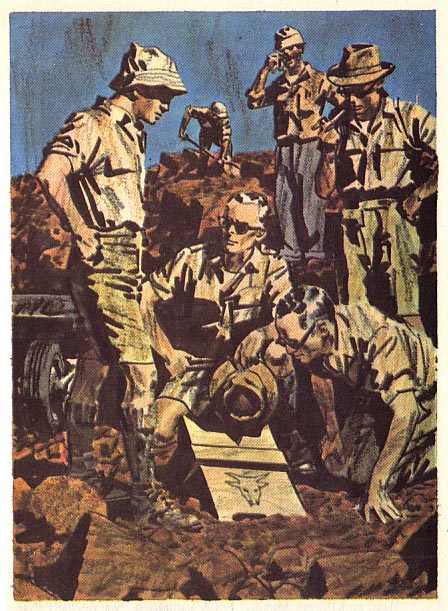

"[The touch is] a joyous thing to perceive in any work of art -- that elevates it far and above its contemporaries, and causes responses of wonder, respect, admiration, and professional envy. It is: "The Majesty of the Simple thing"! (Repeat after me -- 100 times -- "The Majesty of the Simple Thing.") "
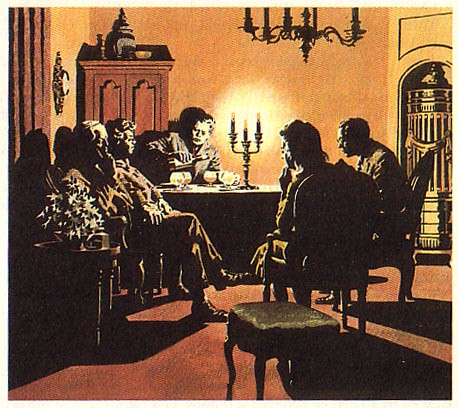

"It is creating a piece of work by a subtractive process rather than an additive one! Once the necessary elements for a story telling picture have been selected and set down on paper in their most effective arrangement, the matter of delineating them remains."
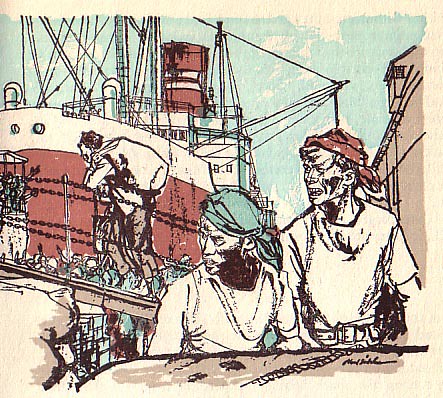

"How one solves the problem, in the "finishing" stages, tells us either too much (more than we really need, or want to know) or not enough!"
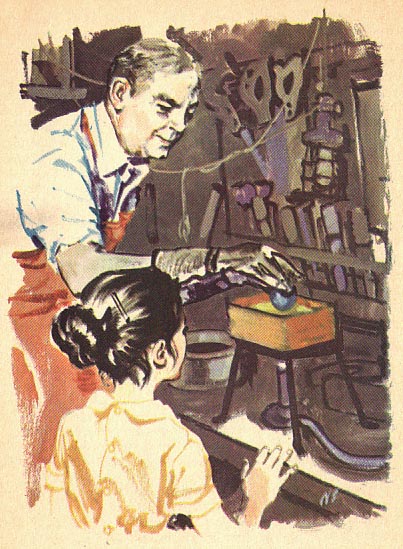

"Ahh, but the artist with that "touch" -- he finds that magical, marvelous balance point between the two choices. His eye, intellect, taste, and hand find the razor's edge dividing them. The final assembly of lines tells us as much about the artist as it does his subject. In economy lies the truth."


"To add to the truth subtracts from it!" A beautiful quote. (Heard or read months ago. Sorry, can't recall the source.)"
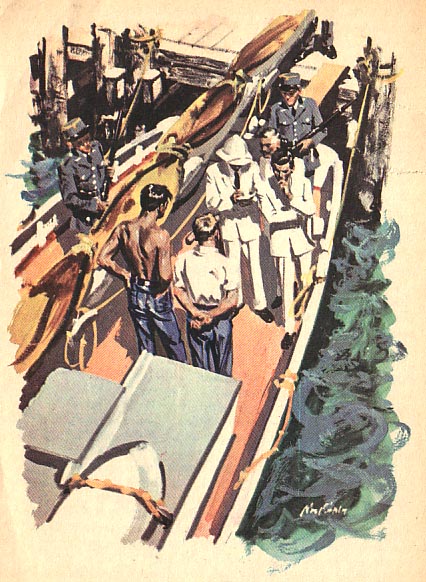

"What I learned from Noel was... an appreciation for economy, clarity, line, mass, pattern, perspective, dramatic moment, subtlety, light source and drop shadow mechanics, negative and positive silhouette values, shapes and the overlapping of same, tension."
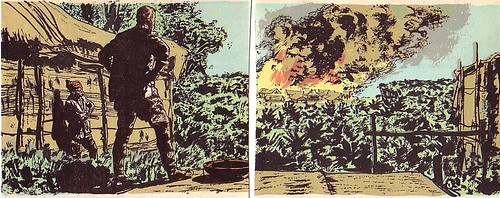

"How much of these studied observations and lessons learnt have actually found their way into my own doodles is a moot question... [But] with elegance, subtlety, and style honed with economy, and with that abundance of talent, Noel produced [artwork] that knocked 'em dead!"

Excerted from an article that originally appeared in The Buyer's Guide © 1977 Shel Dorf

* My thanks to Brian Postman for providing today's scans.

* The book Scorchy Smith and the Art of Noel Sickles is available from Amazon and all bookstores, comics shops, and online retailers. If your local bookstore doesn't have it in stock, they can order it for you: ISBN 978-1-60010-206-6. The text excerpted is © 2008 Bruce Canwell.

* My Noel Sickles Flickr set.

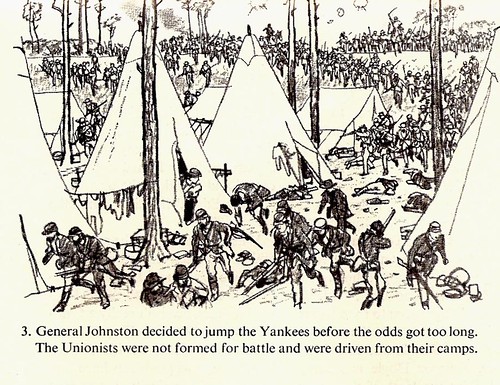
Noel Sickles and the Art of War

When Stephen Crane's American Civil War novel, Red Badge of Courage, was first published in 1895 the public could not believe that the author was not himself a survivor. Crane was born 6 years after the war ended and at the time of writing the novel had never personally experienced battle. Yet he managed to convey such vivid and realistic imagery of the conflict that veterans of the war saw their own personal experiences in his writing.


Noel Sickles, in his own way, might be called the Stephen Crane of 20th century illustration. In his opening remarks in Scorchy Smith and the Art of Noel Sickles Bruce Canwell writes, "His arrival in 1910 allowed Sickles to avoid risking death on the battlefields of Europe and the Pacific: he spent WWI in knee-pants and was in his early thirties during WWII."


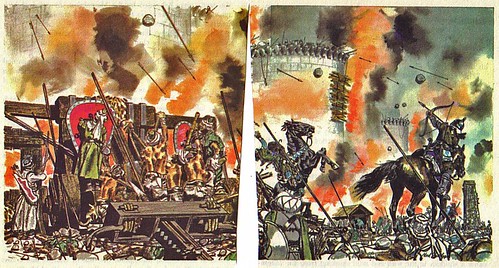
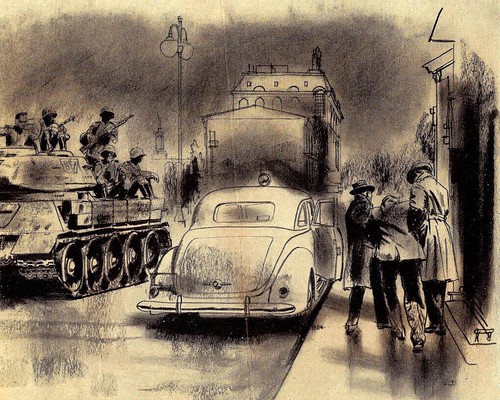
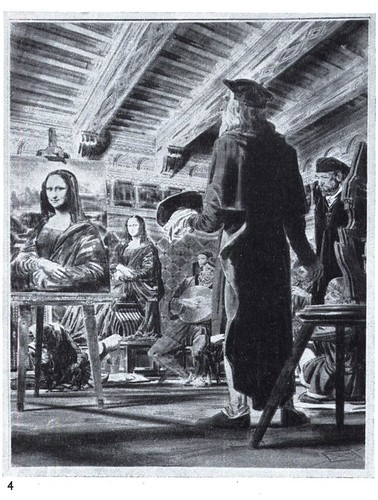
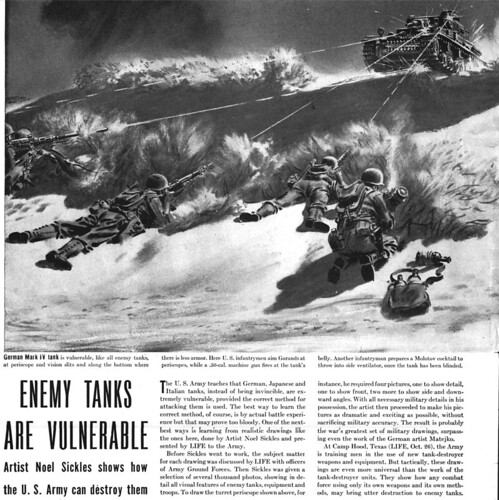
In 1943 Sickles became a civilian employee with the U.S. Navy, creating artwork for a wide variety of purposes, from field manuals to complex "Newsmaps" and built upon a reputation begun two years earlier with a series of assignments for Life magazine, like the one above.

It was his life-long passion for "understanding the construction of things" that allowed him the discipline to create such vivid, realistic works. For the tank article above, Sickles studied "several thousand photos, showing in detail all visual features of enemy tanks, equipment and troops."


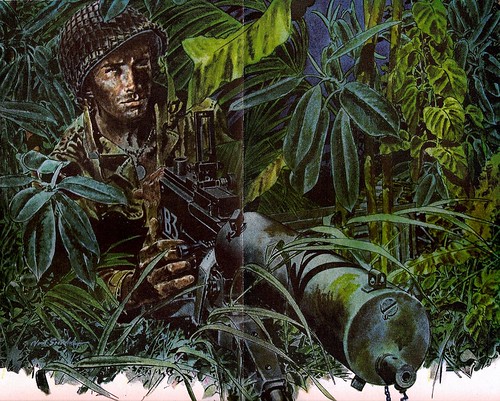
Sickles would later apply that same passion for meticulous research to other assignments involving conflict, historical or otherwise. His friend and fellow artist, Harry Devlin, defined the essence of Sickles' genius:

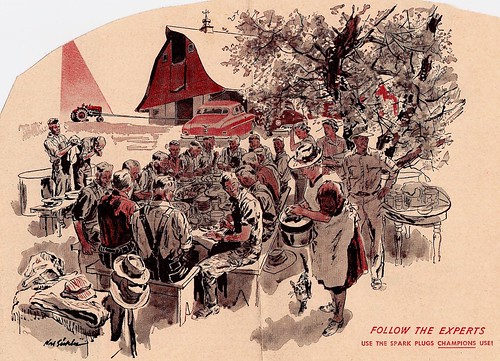
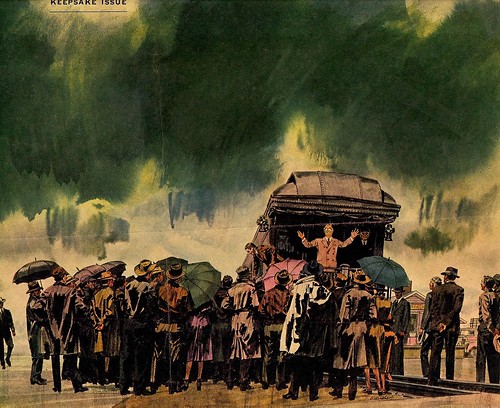
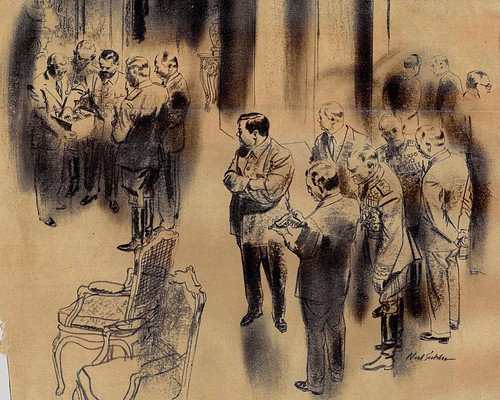
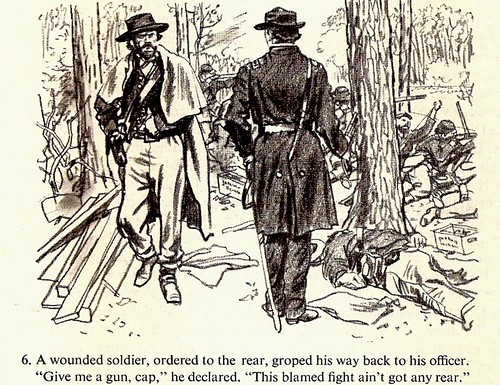
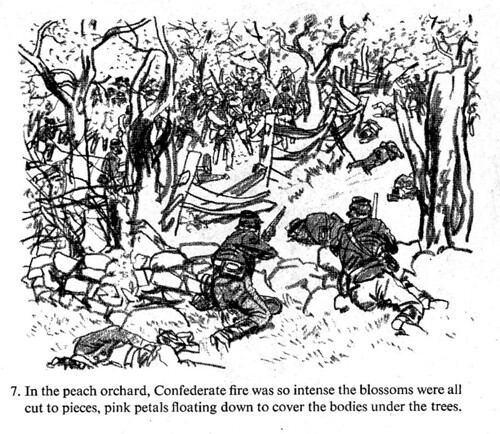
"[His] style... was dependent on a remarkable sense of drawing that was the undoing of so many of his photo-oriented followers. Noel's illustrations could involve 70 figures, horses, wagons, and rugged landscapes. Each face in the figure described a personality, and the costumes were not only individual, but accurate."


Life magazine art director, Charlie Tudor, once said to Sickles, "When I give you something, I know the reader is going to understand it. There's something that you do in your work that makes the thing real to people."


And while Tudor's remark suggests he was somewhat in awe of exactly how Sickles did what he did, the artist, for his own part, once summed up his ability to capture the essence of the art of war with almost Zen-like simplicity: "Not that I'd ever been a soldier," said Sickles, "but I knew all about soldiers. What you do, what you don't do, and so on."


* My thanks to Brian Postman and Charlie Allen for providing all of today's scans.

* My thanks as well to Dean Mullaney for granting me permission to excerpt passages from Scorchy Smith and the Art of Noel Sickles. The book is available from Amazon and all bookstores, comics shops, and online retailers. If your local bookstore doesn't have it in stock, they can order it for you: ISBN 978-1-60010-206-6. The text excerpted is © 2008 Bruce Canwell.

* My Noel Sickles Flickr set.
Tuesday, August 19, 2008

Noel Sickles: Early Years

From Bruce Canwell's biography of the artist in Scorchy Smith and the Art of Noel Sickles we learn that "Bud" Sickles was born on January 24th, 1910, the youngest of six children, to James and Laura Sickles in the town of Chillicothe, Ohio.


Being born into an artistic family, Sickles was not discouraged in his interest in drawing and sketching. He spent many boyhood hours at the library, "studying and copying a wide variety of styles" as well as roaming the local environs drawing everything and anything that struck his fancy. By age 15 he had procured his first paying assignments from the Mead Corporation, which purchased spot illustrations and gag cartoons for the Mead Co-operation, a monthly employee newsletter/magazine, produced for those who worked in the company's Chillicothe paper plant.


At the same time, Sickles "was in the midst of his only formal art training -- the mail-order Landon School of Illustrating and Cartooning."


In 1927 Noel Sickles ventured into the offices of the Columbus Dispatch where he first met the man who would become a life-long friend: Milton Caniff. Caniff, three years older at age 20 and working part-time as a staff artist for the Dispatch said later of that first meeting with the young Sickles, "He liked my work, he said, but when his samples fell out across the desk, they were so good it made me want to jump out the window. He was still in high school at the time."


Sickles regularly made trips into Columbus, Ohio, visiting the local newspapers and meeting their editors and staff artists, and through that perseverence he was able to go directly into a job at the Columbus Citizen on the day after graduating high school.


At age 19, restless and wanting to make more money, Sickles found himself working for the same mail-order art school from which he had taken lessons only a few short years before. Now, instead of being a student, he was correcting the work of others who had paid extra for the privilege of "individual criticism and commentary".

"[It] was boring as hell," said Sickles of his job, and after just six months he quit.


With the Great Depression settling over America one might expect that Sickles would hang onto whatever work he had managed to secure, but after returning to newspaper work in Columbus for only a year or so, Sickles' restlessness compelled him to reject a steady paycheck in favour of a new venture with Milt Caniff. The two young bucks had now been friends for about 5 years. Caniff had recently been let go from the Dispatch, a victim of those times of massive unemployment.


Sickles and Caniff formed a studio and hustled the ad business, turning out work at a furious pace that neither could hope to maintain for long. The venture lasted only 3 months. Caniff received a job offer from the Associated Press in New York and Sickles , in desperation, took on work in Cincinatti drawing theatre ads for RKO. "I had the job to help out this guy, who was doing 'the San Fransisco style', they called it," said Sickles of that unenviable time in his young career. "It would be impossible for me to try to explain what that style was, but it was so horrible for me to do it."


Happily, in 1933, Milton Caniff was able to rescue his friend from his artistic purgatory. "Please come to New York," wrote Caniff from his office at the AP, "We have a drawing board waiting for you."


Noel Sickles career was about to begin in earnest.

* My thanks to Charlie Allen for providing all of today's scans. Be sure to visit Charlie Allen's Blog today for a new CAWS post!

* My thanks as well to Dean Mullaney for granting me permission to excerpt passages from Scorchy Smith and the Art of Noel Sickles. The book is available from all bookstores, comics shops, and online retailers. If your local bookstore doesn't have it in stock, they can order it for you: ISBN 978-1-60010-206-6. The text excerpted is © 2008 Bruce Canwell.

* My Noel Sickles Flickr set.
Monday, August 18, 2008

Scorchy Smith and the Art of Noel Sickles

I often lament that there are so few great illustrators of the mid-20th century who have been the subject of an "Art of..." book collection. One of those artists, Noel Sickles, has finally received his due - thanks to TI list member Dean Mullaney.


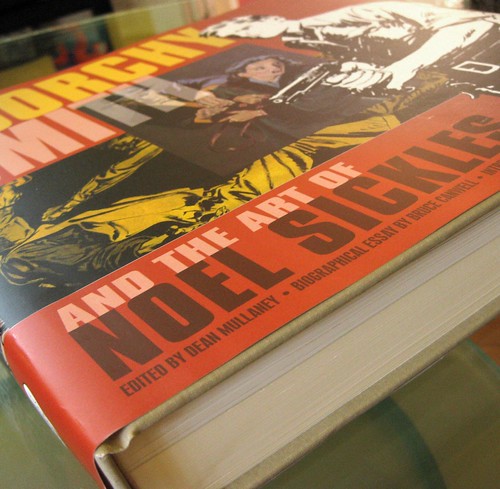
Christmas came early for me last week when "Scorchy Smith and the Art of Noel Sickles" arrived in the mail. I can only imagine that if Robert Fawcett, Austin Briggs and Al Parker (just to name a few) were still with us today, they'd have to be a little envious of this handsome volume.

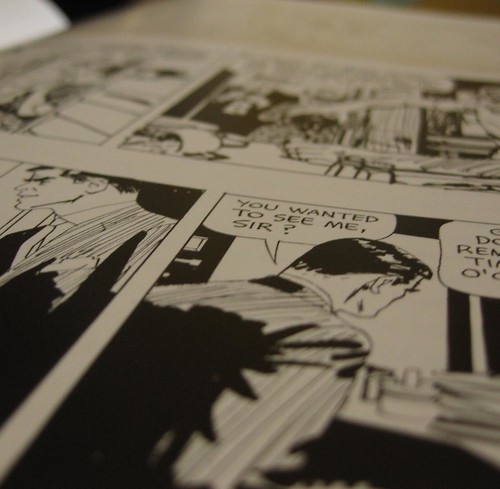
Dean's original intention was to collect Sickles' 3-year run on the newspaper strip, Scorchy Smith...


... and include some biographical material and examples from Sickles' later career in illustration. However, writes Dean, "We found so much incredible art and bio material that I had to add 40 pages to the book. The Scorchy strips don't even start until page 142!"


I was fascinated to see so many examples of Sickles' rough sketches and meticulous attention to research for historical subjects, as shown above.


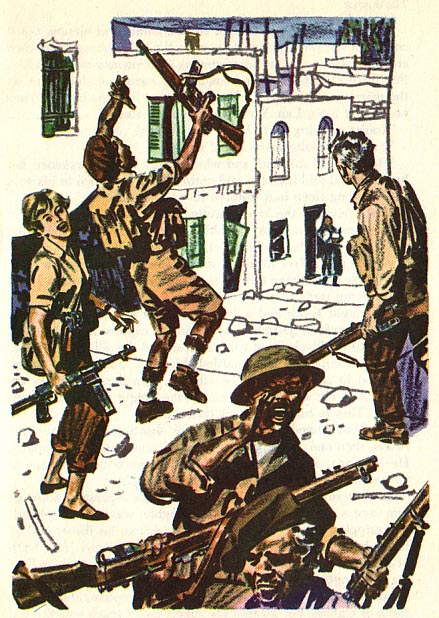
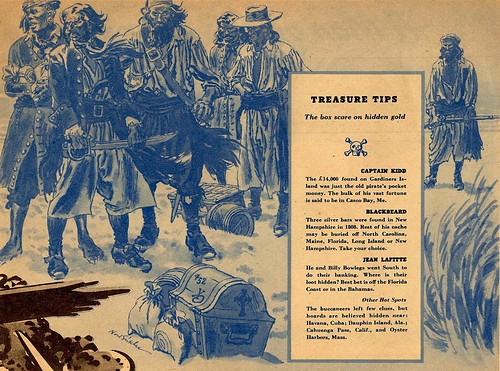
And while we might otherwise have had the opportunity to easily find the artist's work for mainstream publications, the book also collects copious amounts of rare and obscure artwork, like the 1960 recruitment booklet Sickles did for the U.S. military...


... or this unsold 1960's strip, of which Sickles produced only 6 inked and lettered dailies.


There are over 200 pieces of art in the front section of Scorchy Smith and the Art of Noel Sickles, from the artist's youth, through his many decades in commercial art...


... and up to his last work in the early 1980's, just before he passed away.

With Dean's permission, as we devote a week to the art of Noel Sickles, we will dip into the book for the occassional excerpt or anecdote. Many thanks, Dean!


Dean would like you to know that "the book is available from all bookstores, comics shops, and online retailers. If your local bookstore doesn't have it in stock, they can order it for you: ISBN 978-1-60010-206-6."

My Noel Sickles Flickr set.
Sunday, August 17, 2008

At Home with Bob Fawcett

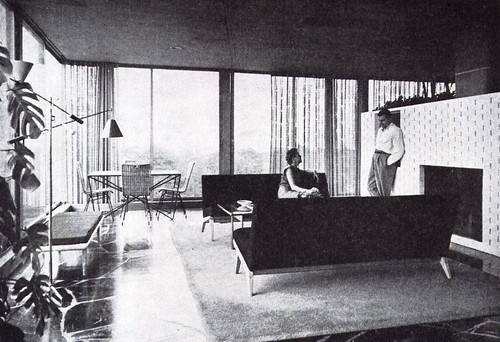
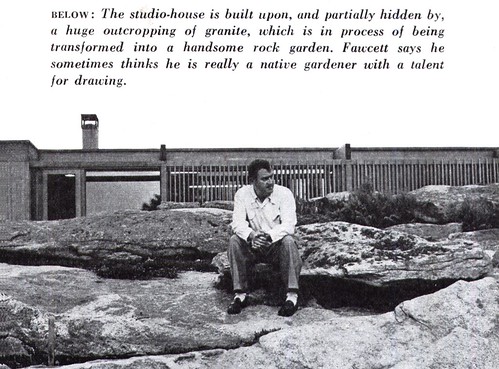
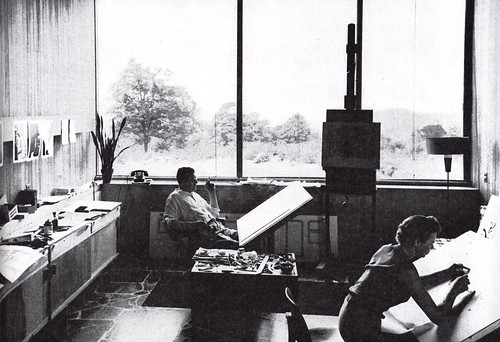
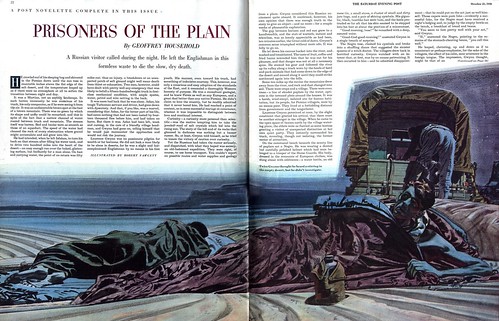
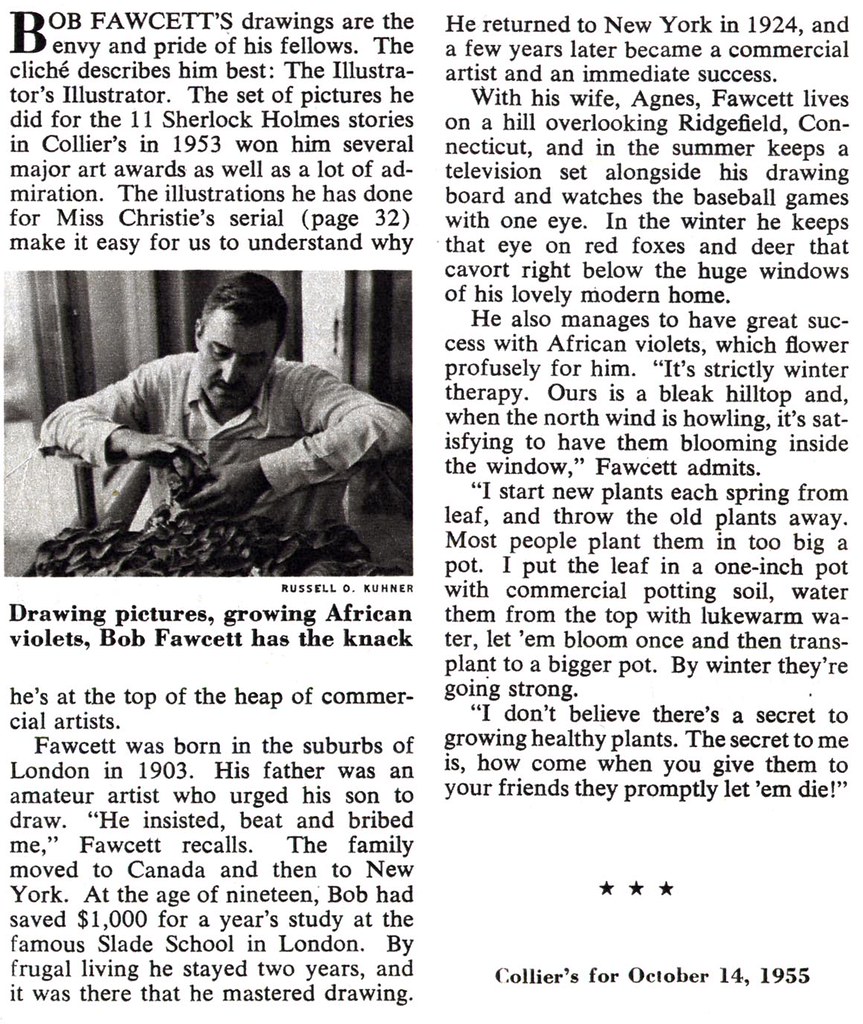
Robert Fawcett and his wife, Agnes, lived in a 'modern-style' home that a November 1954 article in American Artist magazine describes as "severely rectangular". Fawcett did not design the house - but he did serve as a 'general contractor' in its construction.


The floors were made of scrap marble from Vermont, furniture and panelling was done in birch, white brick from Arkansas was used for the fireplace that divided the livingroom from the kitchen...


... and Washington State cedar framed the ten-foot-high, double-paned windows from California.


During the long Connecticut winters, Fawcett raised African violets in his spare time, a hobby he was so successful at that he kept friends in constant supply with them.


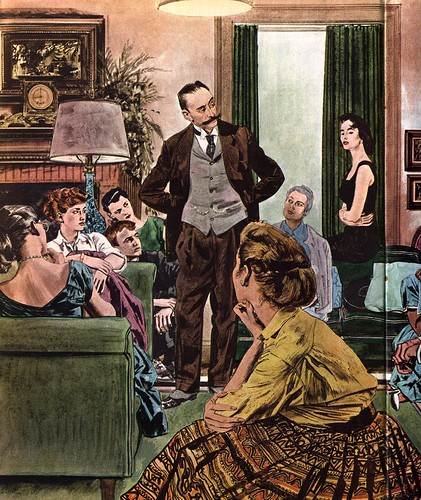
The following year, in conjunction with the illustration at bottom, an anecdote appeared in Collier's again mentioning Fawcett's fondness for raising violets.

More interesting to me though, is the reference to how Fawcett saved a thousand dollars by age 19 so that he could attend the Slade School in London. Stop and think about that for a moment: Fawcett would have been nineteen in 1922. Imagine a 19-year-old raising a thousand dollars in 1922! What must he have done... how hard must he have worked to save that kind of money. The article says that by frugal living Fawcett managed to stay at Slade for two years and that it was there that he mastered the art of drawing.


In the Illustrators Q&A mentioned in Friday's post, Fawcett was asked, "I have often wondered if your work at the Slade School of London and under Edmund Sullivan was of value to you as an illustrator."

Fawcett replied, "At Slade, academic and searching drawing was so insisted upon that draftsmanship became second nature. I did nothing but draw from the model eight hours a day for two years. This experience created a backlog to which I constantly refer even now. I may disagree with some of the preceps laid down, but I will never regret the Spartan grind we went through then."


"As I look back upon it, the standards were so rigid and academic (in the best sense) that in self-defense one had to find a personal expression or be reduced to an automaton, but I think it was not until ten years later that I was able to gain access to what that drawing was doing for me at the time. In the end I think that this kind of training, a discriminating eye and an obedient hand, achieved what it set out to do. The student became so aware of the normal aspect of things that accuracy became no longer interesting, and energy was released for a more creative kind of seeing."

My Robert Fawcett Flickr set.

Friday, August 15, 2008

Robert Fawcett Q & A

In 1950 American Artist magazine introduced a remarkable monthly 'Illustration Q & A' feature. Readers had the unprecedented opportunity to direct pertinent question to some of the top professionals then working in illustration. Among those most often queried was Robert Fawcett. His responses are as relevant today as they were almost 60 years ago (and reveal, I think, some of that character of which we have heard this week):


Question for Robert Fawcett:

Is it necessary to hire professional models to get the best results in my work?

Answer: "Indeed not. I feel that intelligent friends are usually much better for modeling. They haven't been spoiled by acquiring that model's habit of mugging and grinning under all circumstances."


Q: Will an agent really help me sell my work?

A: "An agent is invaluable to the beginner. He has an entree to art directors that the beginning artist does not have, and he can help greatly to build the young artist's career. The difficulty, for the young artist, is to enlist the services of a good representative, for the best of them are beset by more artists than they can handle with integrity."


"The only way to engage the interest of a representative is, of course, to present him with a portfolio of work of promising caliber. After being assured of the agent's reputation and standing, the young artist would be well advised to put his work entirely into the agent's hands and to be guided by his advice. This does not rule out the artist's ambition to improve and change; drawings of the kind of work he wants to do should be constantly added to what he has already done."


"Only in this way do art directors see his latest output. Finding the right agent is an important step that should be discussed with art directors and other artists whose judgement may prove helpful."


Q: Are movie stills a reliable source of historical reference material?

A: "I am wary of accepting movie stills as the last word of authority after an incident which happened to me in Hollywood. During a visit to one of the larger studios I was talking to a woman who was in charge of all research. I told her of the great value we illustrators place in movie stills as sources of historical reference. We assumed, I said, that the research facilities of the movie industry were much greater than our own and we therefore relied heavily on this research for accuracy. She replied that, on the contrary, if a picture had appeared in a magazine such as The Saturday Evening Post, that constituted authority enough for them! I left her pondering uneasily on the extent to which the halt have been leading the blind these many years!"


Q: What is the greatest stumbling block in the path of the present-day commercial illustrator?

A: "The greatest danger in commercial illustration is repetition and the boredom and loss of interest that inevitably follow. The history of illustrative art is full of examples of illustrators who, on the strength of a big success, turned into super-mechanics, only to be shocked and surprised when public enthusiasm gave way to apathy."


"This is even truer when the origianl success was a production of some distinction. I know of no way better to avoid the stumbling block of repetition than to determine to wait for the particular solution to each problem rather than to repeat a recent successful idea."

My Robert Fawcett Flickr set.
Thursday, August 14, 2008

Charlie Allen on Robert Fawcett

Today I thought I'd share a few of the many Robert Fawcett scans generously sent to me by our own Charlie Allen, along with Charlie's insightful observations about the artist.


Be sure to visit Charlie Allen's Blog for the latest installment of his CAWS series, updated today. Charlie writes...


"A lot of RF's in my file... still have scads."


"From my limited experience, meeting and talking briefly twice, and hearing a near diatribe before a group of S.F. illustrators (before SF Society of Illustrators was formed), Fawcett was a complicated, almost irascible, man. May have been his genius, a towering ego, or something else.....but for an artist as prolific, as talented, as successful, a legend in his time...he should have been totally happy and positive. I saw the opposite."


"Have thought for a long time about his general 'state of dissatisfaction', and almost hostile attitude that I saw....and, in spite of his great talents. Brilliant people often have unusual personalities....but it just may have been as simple as financial reward. Top lawyers, surgeons, business men, certainly actors, athletes, entertainers, etc. command much higher incomes than the average. This really wasn't the case with illustrators....with a few exceptions."


"Again, enough history. Cheers.... Chas."


Many thanks to Charlie for sharing these scans and his thoughts on the artist- and be sure to check out CAWS # 7 at Charlie Allen's Blog.

* My Robert Fawcett Flickr set.