A couple of days ago on Facebook,
Dan Zimmer of Illustration Magazine shared some sad news: last weekend, Mitchell Hooks passed away.

How particularly strange to hear Mitch was gone,
having just featured his work once again only a couple of weeks ago right here on the TI blog. I had some wonderful phone conversations with Mitch and, in 2010, I actually got to meet him, talk with him in person over
a long lunch at the Society of Illustrators and shake the hand of one of my illustration idols. I will always cherish those memories. Mitchell Hooks was a spectacularly talented artist and a warm, humble and generous person.

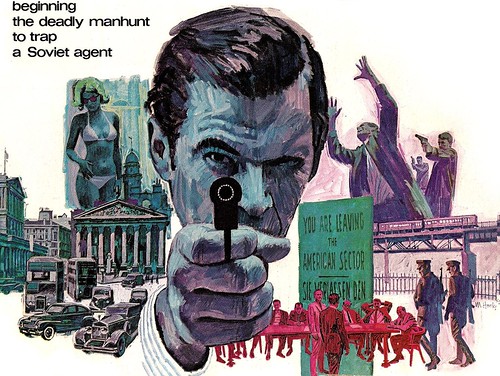
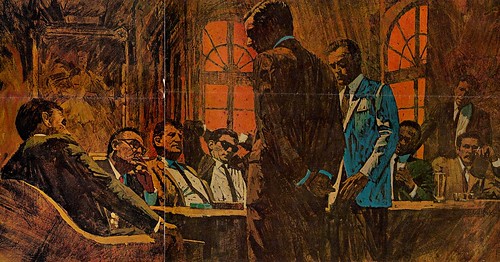
The illustration at the top was published in
Redbook magazine in July 1961. The one immediately below in April '61.

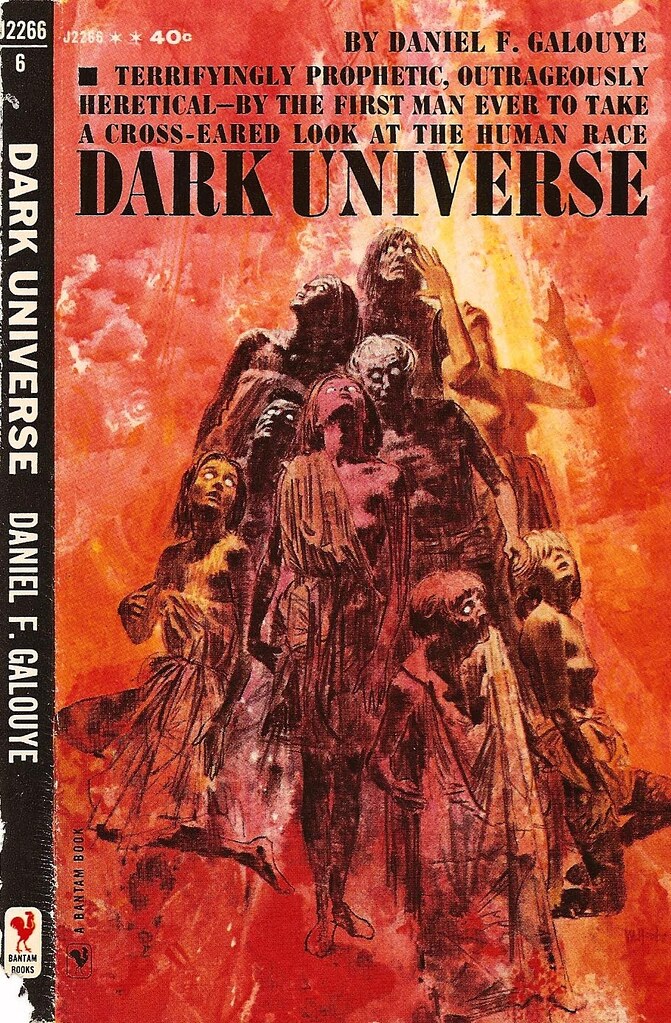
Here are a few more pieces by Mitchell that I haven't previously presented. These are from
Reader's Digest Condensed Books, circa 1980.


In Mitchell's memory, I'm re-presenting Part 1 of my interview from 2008...
Mitchell Hooks: "I always drew..."
(First presented on Tuesday, September 09, 2008)
Mitchell Hooks was born in 1923 in Detroit. He didn't come from a particularly artistic family, though he did have an uncle whom he describes as 'quite a good self-taught artist' who encouraged his interest in art. Says Mitch,
"I always drew."

His earliest influences were the adventure strips in the newspaper, especially
Alex Raymond's Flash Gordon, Jungle Jim and Secret Agent X-9.
"As a boy, I followed Raymond's work avidly," chuckles the artist today,
"even to the point of clipping out the strips and keeping them in a scrapbook. I'd meticulously cut out the figures of Flash, Dale and Dr. Zarkov."
"I've always had an affinity for anatomical drawing and, in retrospect, I can attribute my abilities to the long hours spent studying Raymond's beautiful drawings."

Mitch attended CAS Technical High School in Detroit,
"A marvelous school," that had been created for those city kids who really had no hope of ever attending college.
"The way we grew up," says Mitch,
"we didn't even know how to spell 'college'."
 "CAS was loaded with professional illustrators, designers and such, just great people, who taught us everything we needed to know to get a job in the profession."
"I was thrown in with a bunch of kids who were really enthusiastic about illustration. We all knew what was going on out there in the magazines... knew about Al Parker and the Cooper guys and all that, and CAS prepared us to go out in the field - and we did - we all went out and got jobs in the field, straight out of high school!"
"CAS was loaded with professional illustrators, designers and such, just great people, who taught us everything we needed to know to get a job in the profession."
"I was thrown in with a bunch of kids who were really enthusiastic about illustration. We all knew what was going on out there in the magazines... knew about Al Parker and the Cooper guys and all that, and CAS prepared us to go out in the field - and we did - we all went out and got jobs in the field, straight out of high school!"
 "CAS was where I made my big leap from Alex Raymond to wanting to be a professional illustrator, and I knew I wanted to be in New York."

When Mitch graduated from CAS he first found a job at General Motors. The war was on, GM had been converted to supplying the American army with equipment, and Mitch was assigned to take two dimensional blueprints and convert them to three dimensional drawings.
"It was important work," says Mitch,
"and I hated it."

Hated it so much that just a couple of years later, when he joined the army, he made sure they knew nothing about his artistic abilities.
"I was so afraid that they'd assign me to do more of those drawings that I intentionally flunked any tests that might reveal my skills." Mitch decided he's rather risk the shooting war than get stuck doing any more dreaded blueprint drawings! He became an infantryman in 1944 - and served as a second lieutenant with the U.S. occupation forces in Germany after the war ended.

Upon his return to the States, he made his way to New York. He had freelanced in Detroit for a year or so after leaving GM, and had diligently prepared a portfolio of samples he hoped would land him the sort of work he wanted to do. A previous visit to the the Big Apple before his army service had resulted in an opportunity with a minor studio called T.J. Peters.
"Peters had a small bullpen of artists and I got on staff there," says Mitch. But all the while he was looking for something bigger, and that came in the form of freelance work done on the side for Al Chaite.

Chaite would go on to form, with artist Harry Fredman, one of the major players in the New York commercial art scene: the high-profile Fredman/Chaite Studios... but for now he was managing a smaller operation called Trager-Phillips. Mitch, while working at Peters, found plenty of freelance opportunities with Trager-Phillips, and
"it caused a small conflict with my boss at T.J. Peters."

You can read what became of that conflict - and much, much more - in the remaining three instalments of my 2008 interview with Mitchell Hooks:
Part 2
Part 3
Part 4
*
Tomorrow I'll present a raft of illustrations by Mitchell from Reader's Digest Condensed Books.
*More art in my
Mitchell Hooks Flickr set.