Showing posts with label Franklin McMahon. Show all posts

Friday, February 15, 2013

The Franklin McMahon Interview, Part 3: "This is my serious work."

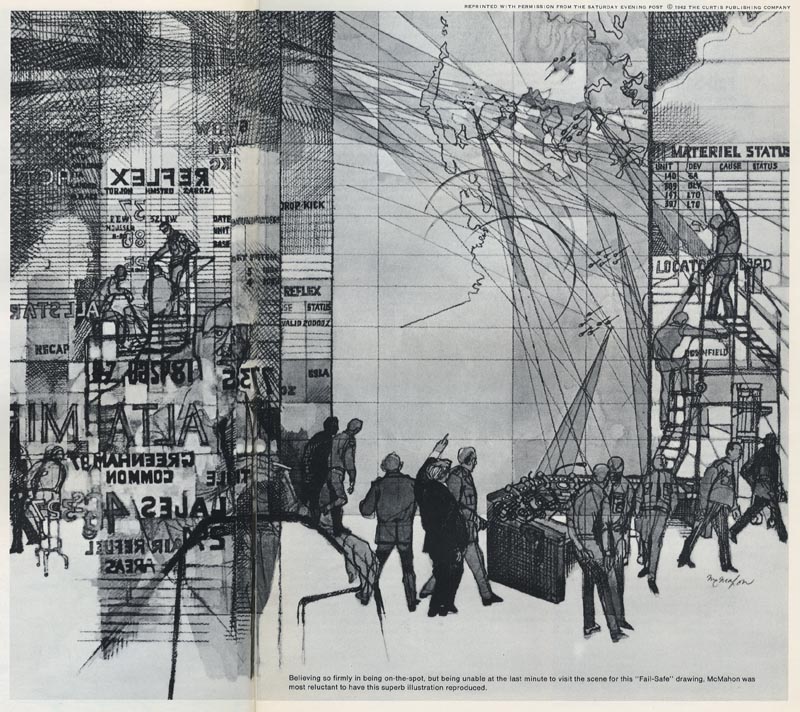
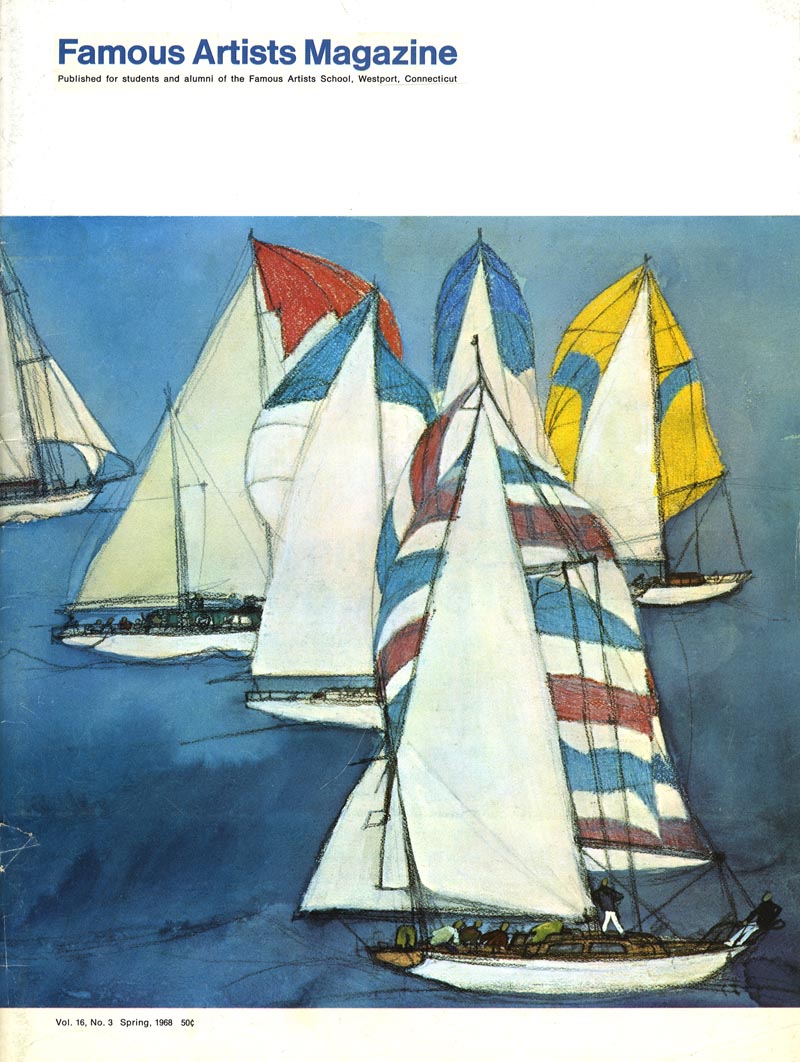
The Spring 1968 issue of Famous Artists magazine contained a feature article and interview with Franklin McMahon. Earlier this week I presented the first and second parts of that interview. Today we look at the conclusion...

FAS: You cheerfully admit that even when nobody asks you to cover a story you go ahead and make the drawings and then, hopefully, find someone to publish them. Do you like working on speculation?

McMahon70

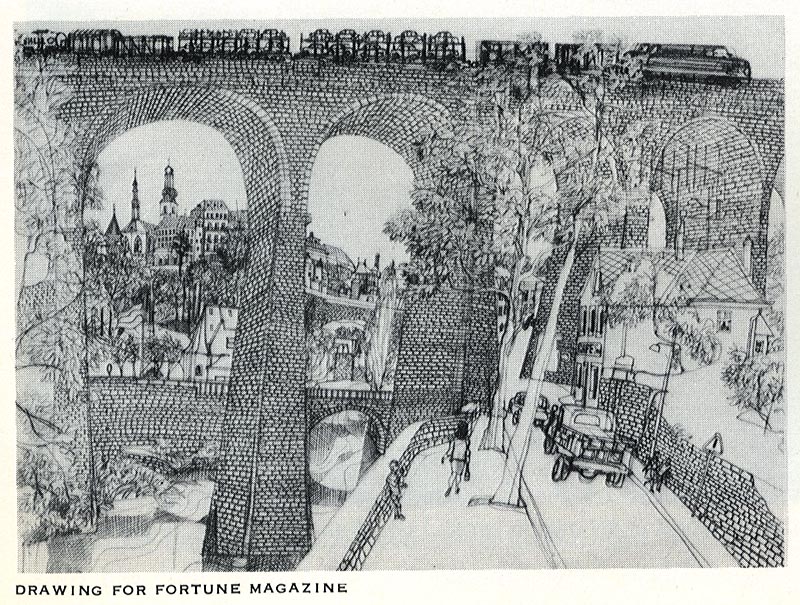
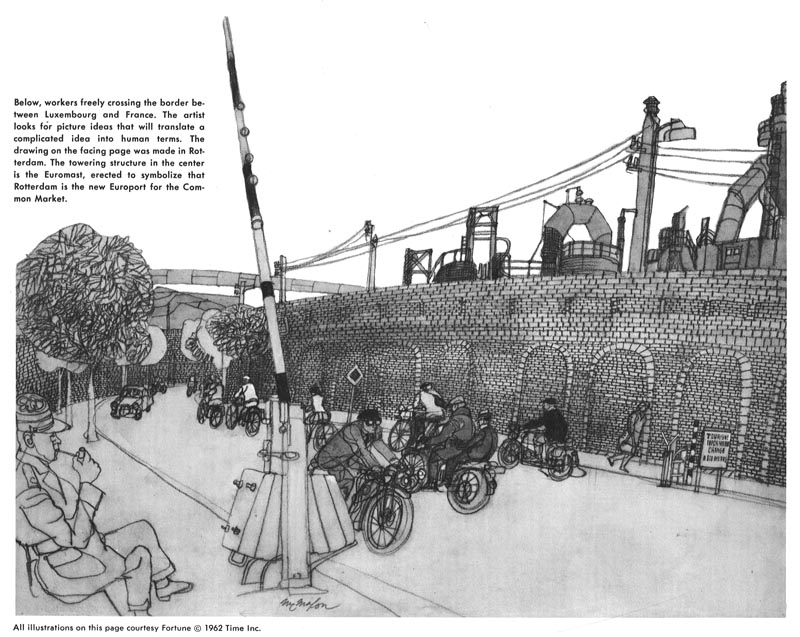
FM: I query somebody when I have a good idea or I go ahead and find a place for it later. Nobody gave me an assignment for my Common Market story, which I sold to Fortune.

(Below, McMahon illustration from his Common Market series for Fortune magazine)
McMahon73

The reason you go ahead is the possibility of a big exciting payoff if you keep your eyes open. Timing is important. An editor may tell you, "We're not doing that kind of story." What he means is, "We're not doing it this week." But his interest could develop. After the second or third look he may want the story. Particularly when the subject has been exhausted and a new look is needed.
McMahon44

FM: The magazines can do stories to illuminate a subject before it becomes a problem and even anticipate the headline. I suggested to a magazine that they do a story on what the people of Birmingham were thinking long before they turned the hose on them.
McMahon75

FAS: Why don't magazines take more of a chance?

FM: An editor doesn't know what's out there. Neither do you until you get there. That's why you have to go and find out. When you get there the story begins to turn over, but sometimes not until you're in the middle of it. I'm not talking about exposés. The artist can celebrate the things that are positive. It's a question of the artist interacting with a meaningful subject, something that interests him.

McMahon62

FAS: What interests you?

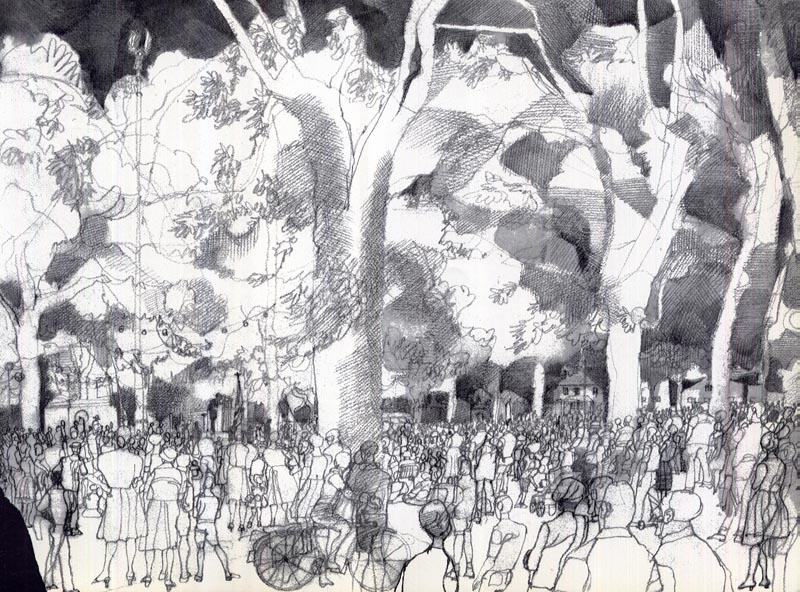
FM: One thing that interests me is civil rights. The Vatican Council and the way it relates to civil rights, non-violence, which seems to be the major theme of our times. It's what the young people in the streets are thinking about. I don't think Churchill is really the man of the century. Probably Gandhi.

(Below, a crowd in India listens to Vinoba Bhave, Fortune magazine, 1963)
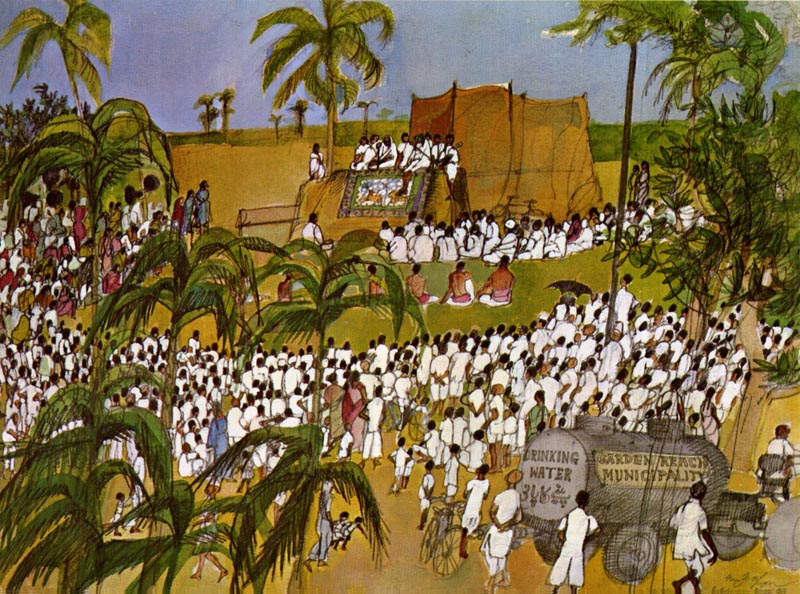
McMahon56

FM: I'm interested in the changes taking place in the established church. What goes on is so much conditioned by the relationship of Christians to Jews. The Ecumenical movement, bringing people together, becoming a world society - these are the kind of things that interest me. My first consideration is to do stories that interest me and then do them so they are published.

FAS: How do you develop a reporter's eye?

FM: Keep your mind open. I think there's a story everywhere. There are certain visual ideas, reportorial ideas, actually, that are best expressed in art. There is no way of knowing what ideas these are until you go out and look around.
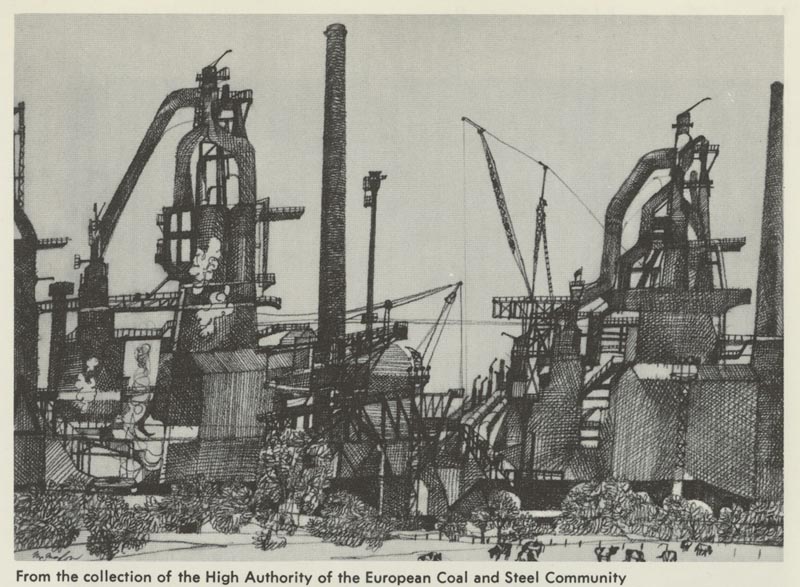
McMahon68

FAS: When you go out after stories that interest you, do you go out with an attitude, an editorial point of view?

FM: If I have an attitude, I would like to stop having it. When you start out on a story you probably do have some preconceived idea of what you will find. but going there changes your idea of what a place is like. What you suddenly realize in Selma, for example, is that this is a condition of humanity. There are good people on both sides who want to work it out and bad people on both sides. All your notions are scuttled because you are dealing with human beings and not symbols.

(Below, the head of the Chamber of Commerce, Birmingham, Alabama)
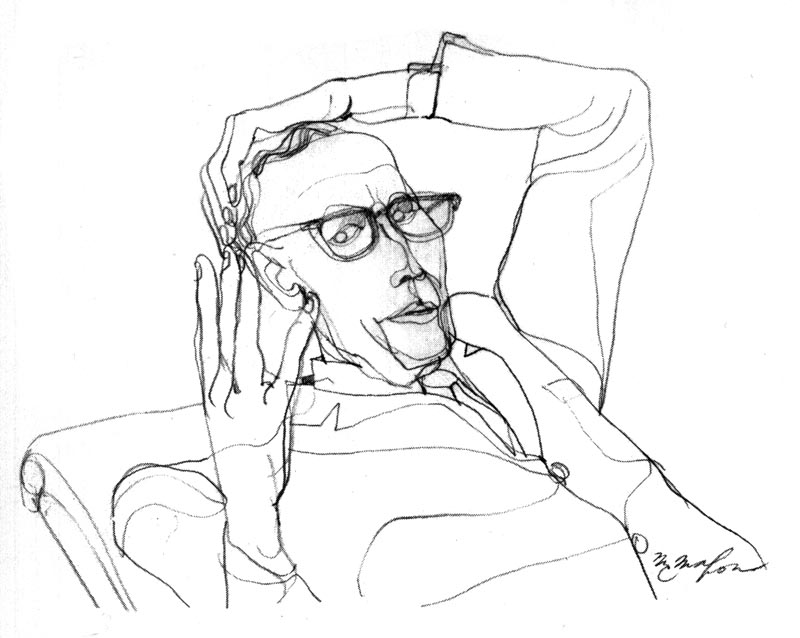
McMahon60

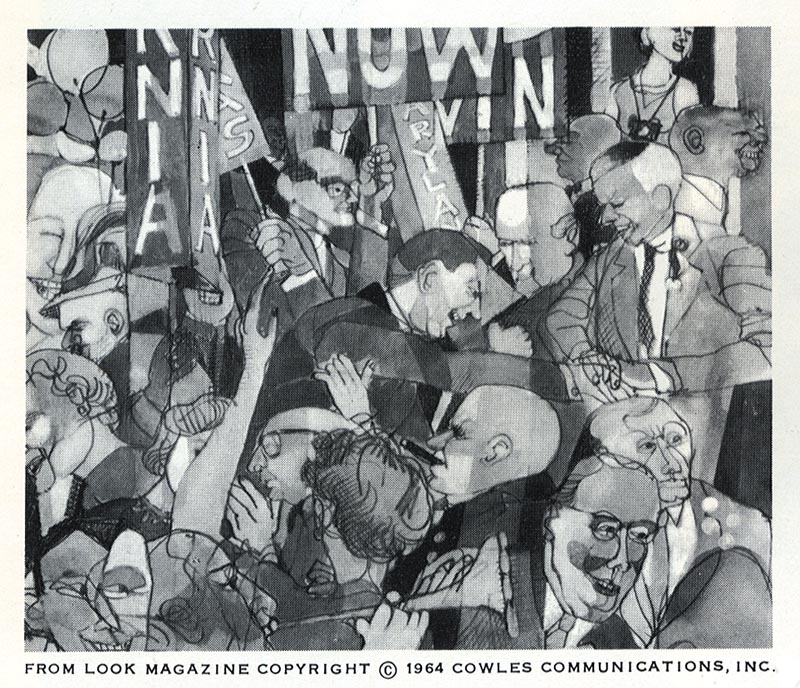
FAS: You seem to have no trouble getting into conventions, conferences, going where the action is. How do you get in? What kind of accreditation do you need?

FM: You have to look for the public relations guy and explain what you want to do. the artist is unique, and there is no machinery set up to accommodate this. usually there is a man who handles writers, and one for photographers. At political conventions I go to the press guy who deals with writers. When I was doing the Common Market story and I wanted to interview Lord Hinchley I called the headquarters of the Conservative Party and explained what I wanted to do and the press man called him and arranged it. Most people want to get their ideas across and you can help them do it. There's no reason why they shouldn't welcome an artist. The only problem is finding the right contacts.
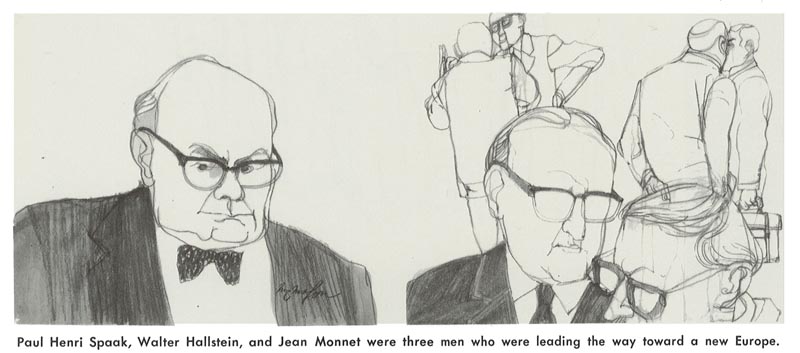
McMahon74

FAS: I notice that you not only describe yourself as an artist/reporter, but you also volunteer to do the text for a drawing and make layouts for the project you're working on. Your training must have been very comprehensive. Was it?

FM: I went to the Chicago Art Institute, the Institute of Design in Chicago and WPA art classes. I went mostly at night because I apprenticed in an art studio as soon as I got out of high school. The WPA sessions were simply life classes. I studied painting and materials at the Art Institute. Chicago is a design center in the sense that the artists who work there have a primary interest in developing their pictures for printing. You take a thing from the start. You aren't called in at the end. When I did something for an agency I wanted to do the layouts too. The total thing.

McMahon66

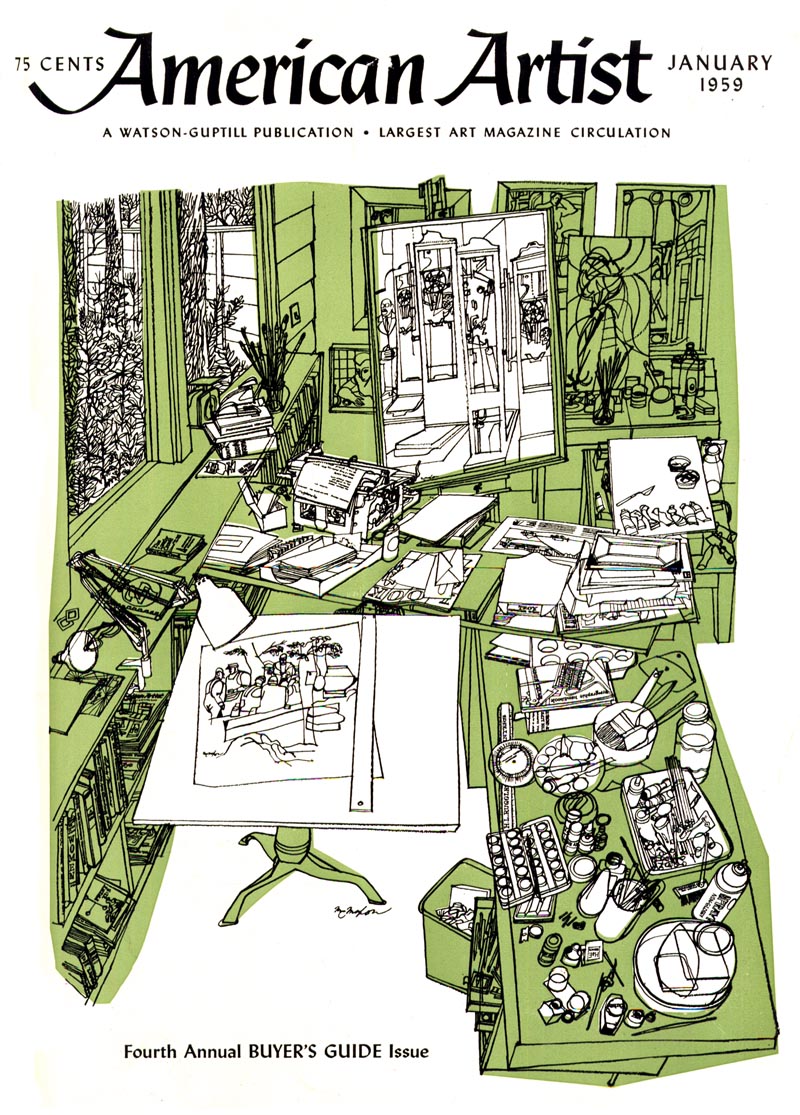
FAS: Where do you work when you are not out on location?

FM: I have a studio in my house and one in Chicago. Increasingly, I work at home. I have a small office in Chicago which I share with a designer.
McMahon01

FAS: When did you really begin concentrating on reportage?

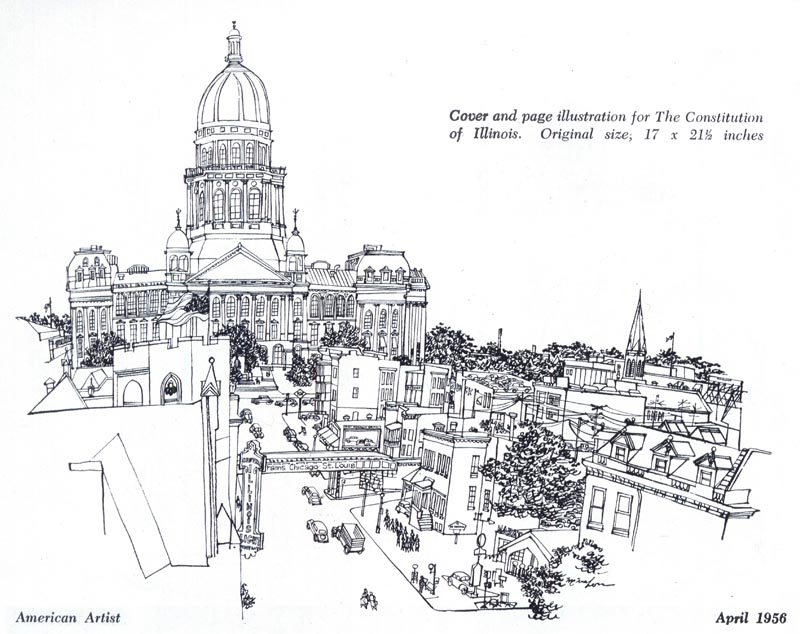
FM: Around 1955, when I decided I was spending too much time in the studio. The first chance I had to get out came when I was offered a job illustrating a book on the Constitution of the State of Illinois. Rather than doing a kind of organization chart with drawings showing what the Legislature did and the Governor did and so on, I proposed that I would go out into the state and see how the people lived under this Constitution.
McMahon06

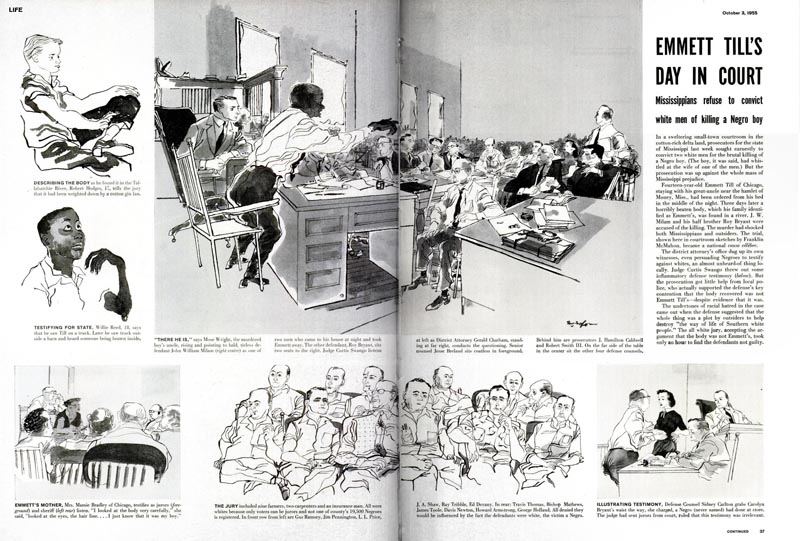
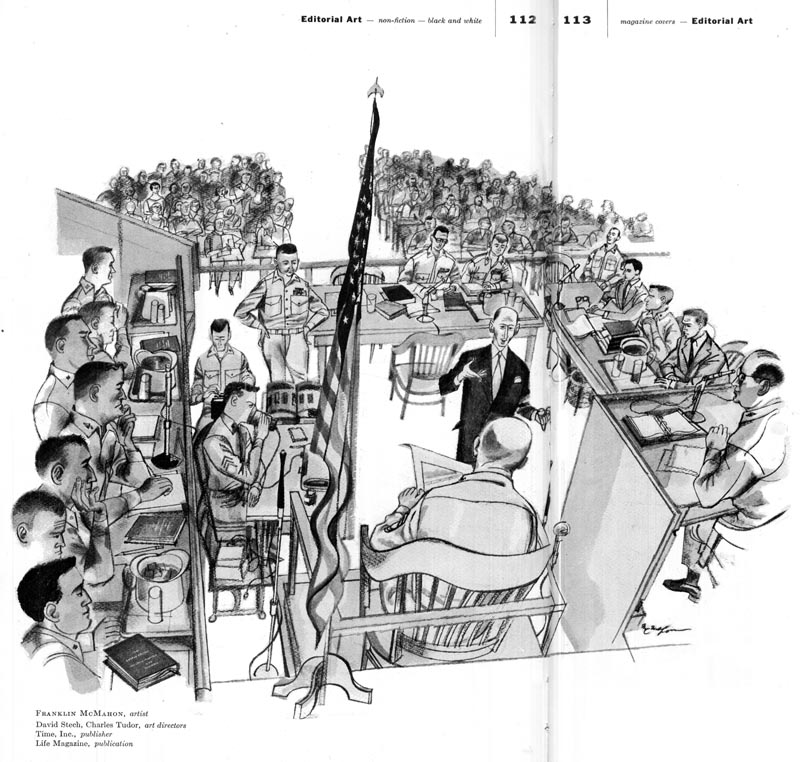
The effect of the laws on transportation in a small city, for example. In a way, what I was doing was decorative art because the pictures could be used anywhere in the book and did not specifically illustrate a given piece of text. I sent the book to Life as an example of the kind of work I wanted to do and they gave me an assignment to cover the Till trial.

(Below, McMahon art from another courtroom reportage assignment for Life magazine, from the 1957 NYAD Annual)
McMahon67

FAS: How can an artist break into the sort of reportage you do? After all, you have the contacts, the reputation and the resources to finance these exploratory trips.

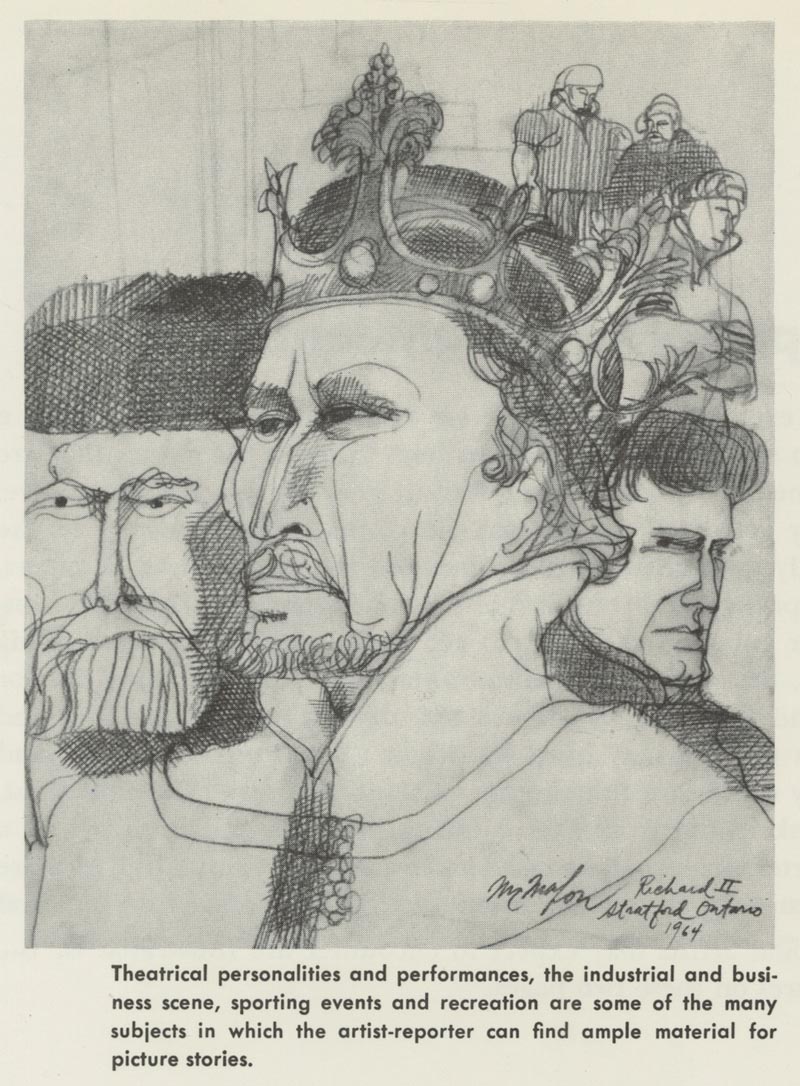
FM: Not every artist will want to go to India or be interested in the Common Market. A guy could work for his local newspaper. There are companies in his area who might want to do an annual report. Regional and local advertising agencies might give him assignments. He should be observant. You ask yourself, "How does this look?" Not many have really done this.
McMahon69

FAS: Do you ever paint for pure pleasure or make a fine arts painting instead of something to sell?

FM: I don't see much difference between work done for publication and work done for galleries and museums. This is my serious work. There's too much talk today about divisions in the arts between commercial and noncommercial, about one as serious and the other as nonserious art. Most great artists in history were commercial artists - they earned their keep by painting for their patrons. I can't work today for Philip II but I may do commercial work for Container Corp. of America of McDonald's Hamburgers.

McMahon71

FAS: You have managed to "do your thing" and be rewarded for it. But clients seek you out because of your individual approach. What advice can you give the artist who is not yet firmly established and who must do what the client wants but also wants to express his own point of view and approach?

FM: He should do his job the way they ask for it but try to go beyond what's asked because they never ask you to do what you're capable of doing. They don't know what you can do. The artist can see things others can't. Do what's asked - but always do something for yourself as well.

* Many thanks to Matt Dicke, who provide most of the material for this week's posts.

Wednesday, February 13, 2013

The Franklin McMahon Interview, Part 2

The Spring 1968 issue of Famous Artists magazine contained a feature article and interview with Franklin McMahon. Yesterday I presented the first half of that interview. Today we look at the second half...


FAS: You said you don't have much time to change your mind when you're out in the field. Don't you ever feel rushed and too pressured to work well?

McMahon43

FM: If an editor sends me two thousand miles to do a series of drawings of, say, a political event, that's what I've got to do to the best of my ability. I can't get there and decide that, that day, I would rather draw a bowl of flowers.

McMahon57

FM: I feel that the artist-reporter faces more of a challenge than the artists who pursues his own ends in a studio. But he is rewarded too. I think you gain from the interaction, from the pressures and the excitement. It doesn't lessen the art. It adds a dimension of immediacy.

McMahon53

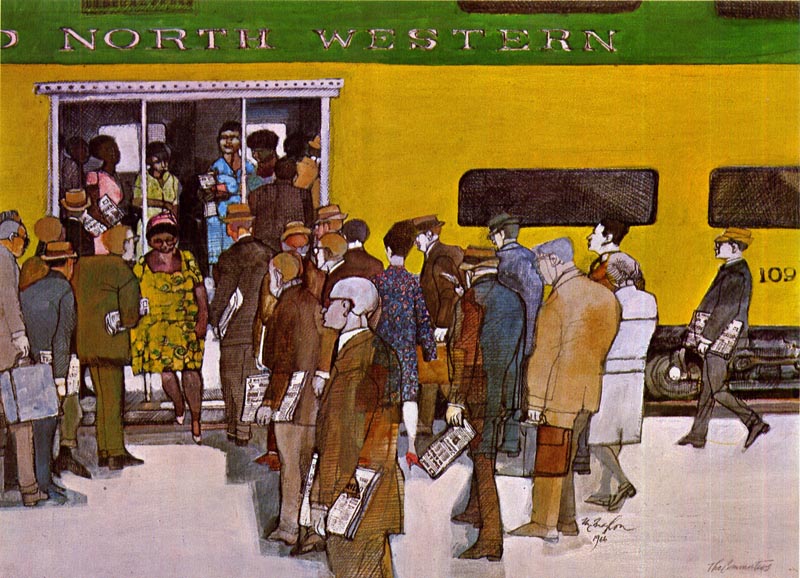
FM: Working, at the moment, you feel an interplay of attitudes, your own and those of the others involved in the action, and you see it from several sides. The artist-reporter - and I would define myself as an artist who is involved with the events of his time - not only sees, but he interprets.
McMahon52

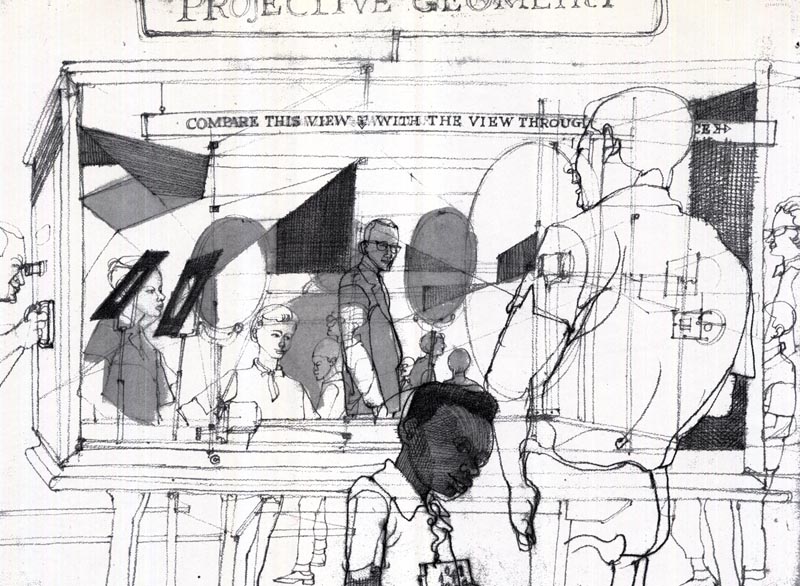
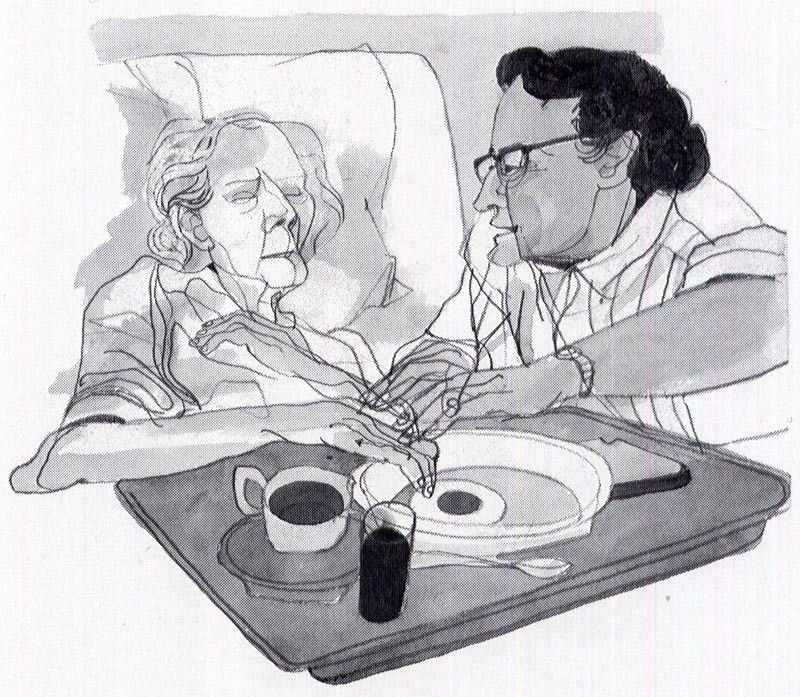
FM: He gives an event meaning by seeing it from another dimension, somewhat as a cubist painter works. He can see around corners of time as well as space, to give his picture depth as well as significance. The artist-reporter can do most of the time what only the best photographers can achieve sometimes. He can look behind and ahead of an event for its meaning.
McMahon47

FAS: Your work proves how immensely valuable the artist-reporter can be when he covers events. Yet most magazines and newspapers still rely on photography more than art to capture the happenings that make history. Why hasn't the artist had more impact on reportage?

FM: I don't want to give the impression that I'm arguing that the artist's coverage of an event is superior to the photographer's. They're entirely different and both of them have their merits. The editors don't really understand what the artist can do for them. In the publishing field they tend to see things as photographically interesting. When the Alabama police turned the hoses on those racial demonstrators, it made a terrific photographic image.

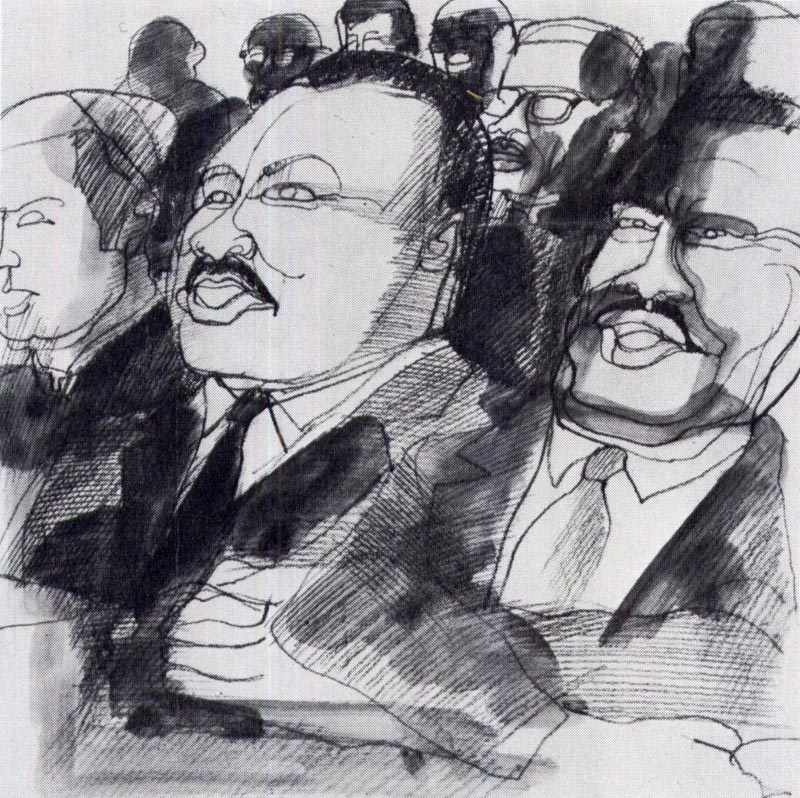
(Below: Dr. Martin Luther King Jr. speaking at a suburban rally in Winnetka, Illinois)
McMahon22

But the photographs didn't tell the whole story. They didn't tell what kind of people they were, how they got there, where they were going. This is the kind of thing the artist can do.

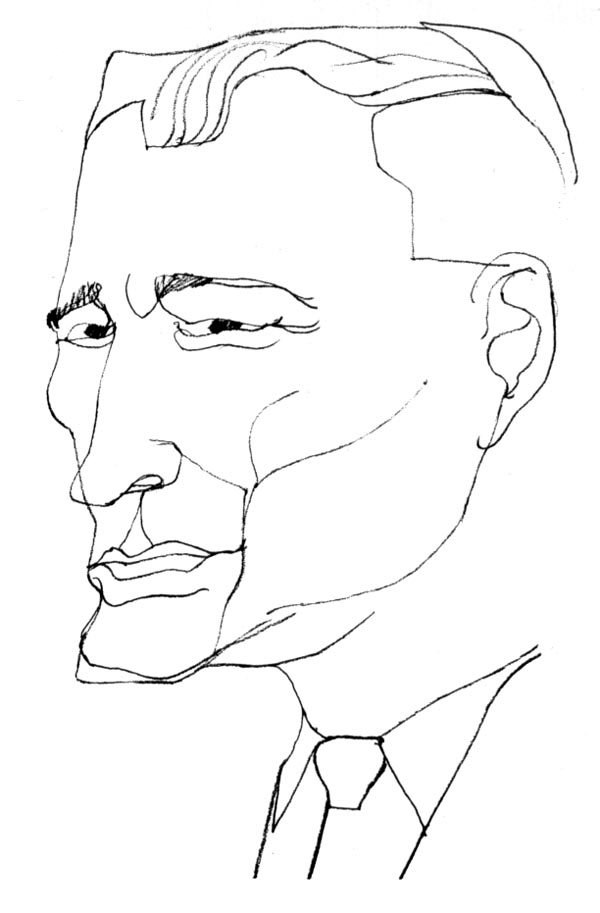
(Robert Shelton, Imperial Wizard of the KKK, drawn in Birmingham, Alabama)
McMahon59

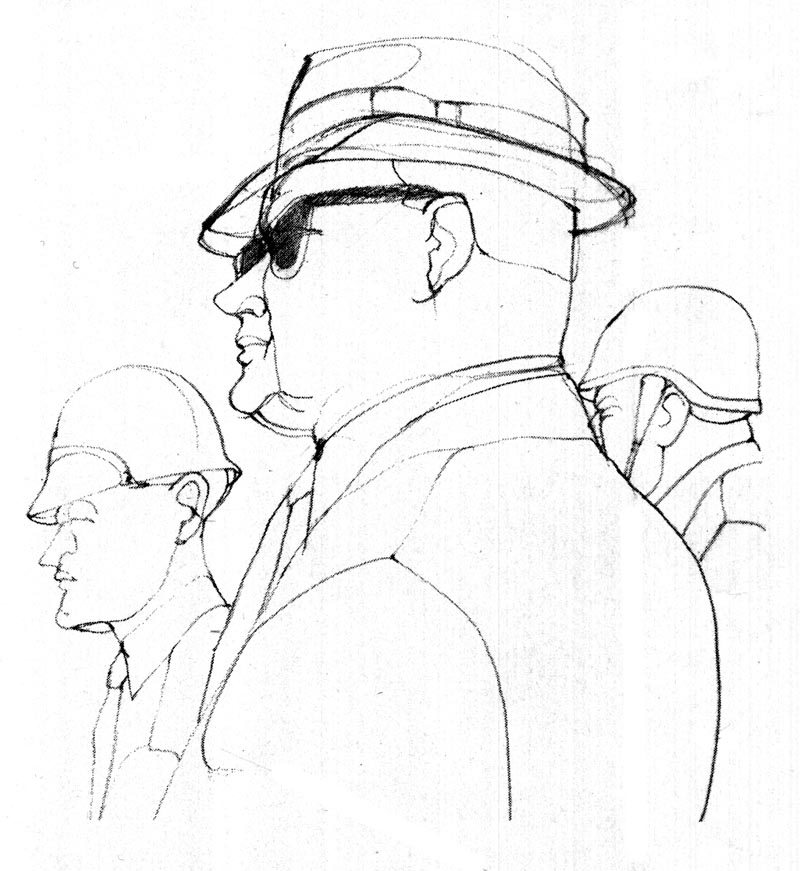
(Dallas County sheriff, James Clark, drawn in Selma, Alabama)
McMahon58

FM: However, these possibilities haven't been recognized by artists, so they haven't been recognized by editors who buy their work. There is a photographic approach and an artist's approach. It's not so much a question of the artist going against realism as it is of heightening the reality. There is a second look, a different look, which the artist can pull out of the story. The artist can get into the minds of people. He heightens the color, makes the story sharper. This is the excitement of art.

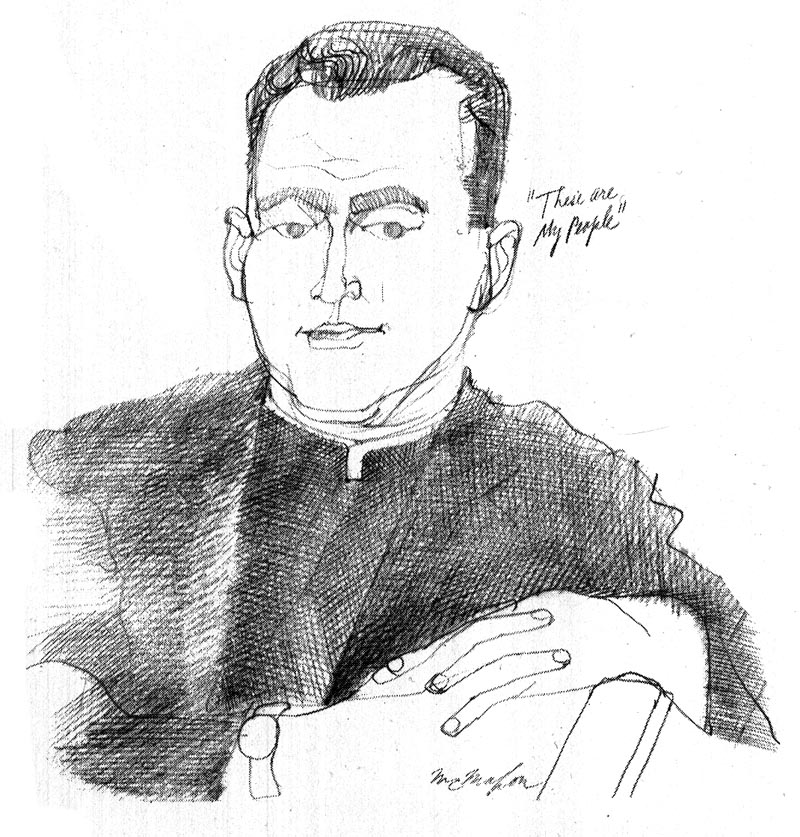
(Father Maurice Ouellet, former pastor of the "Negro" Catholic Church in Selma, whom McMahon interviewed during the demonstrations, and the first white man involved in the voter registration drive. He was subsequently transferred.)
McMahon61

FAS: Someone once said that you put that "extra dimension of meaning" into your pictures. Is that done consciously or is it simply the natural outgrowth of an artist's view of life?

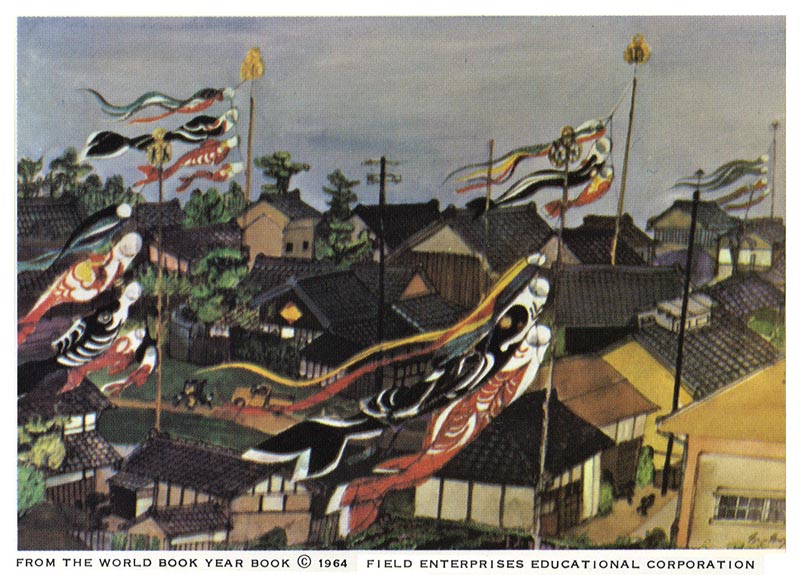
FM: What I look for is a symbol, the significant detail that will tell the story. When I did a picture of Japan's Boy's day I noticed all the carp flags flying. It's a day when they celebrate their sons. Every family flies cloth carp flags from their roofs, one for every son. So I let the flags dominate the picture.

McMahon46

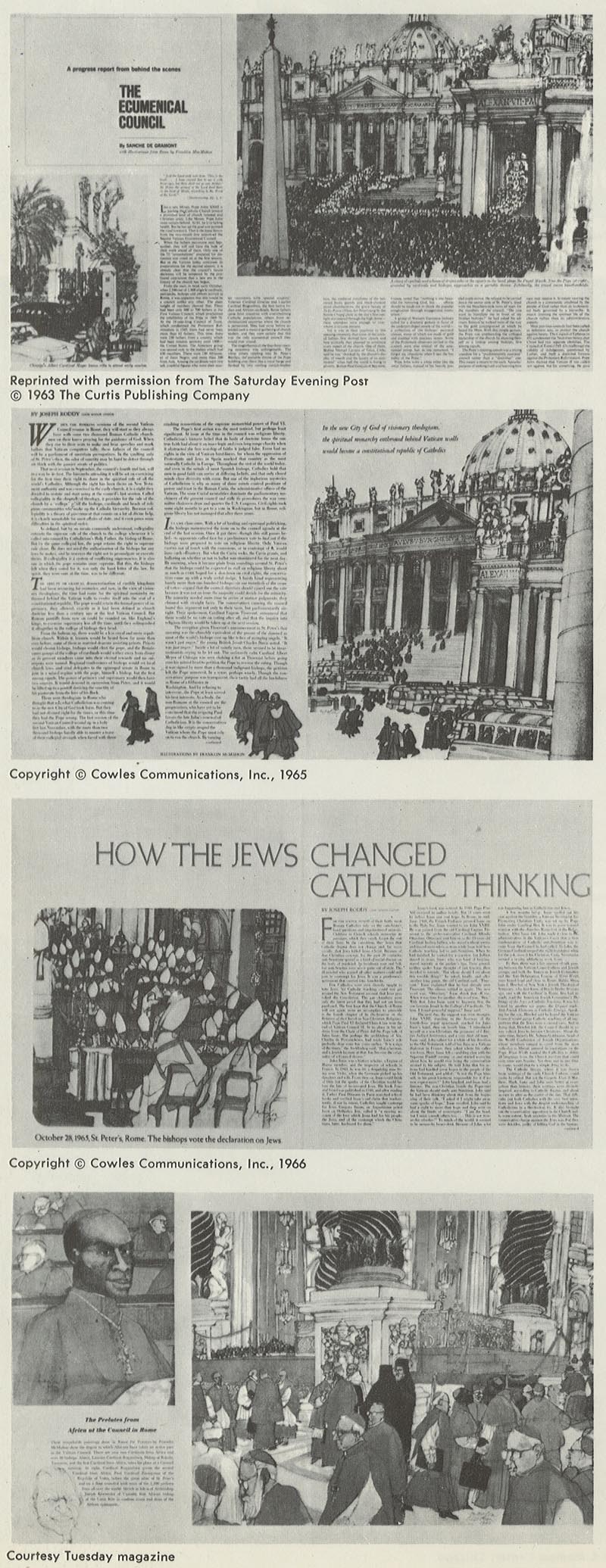
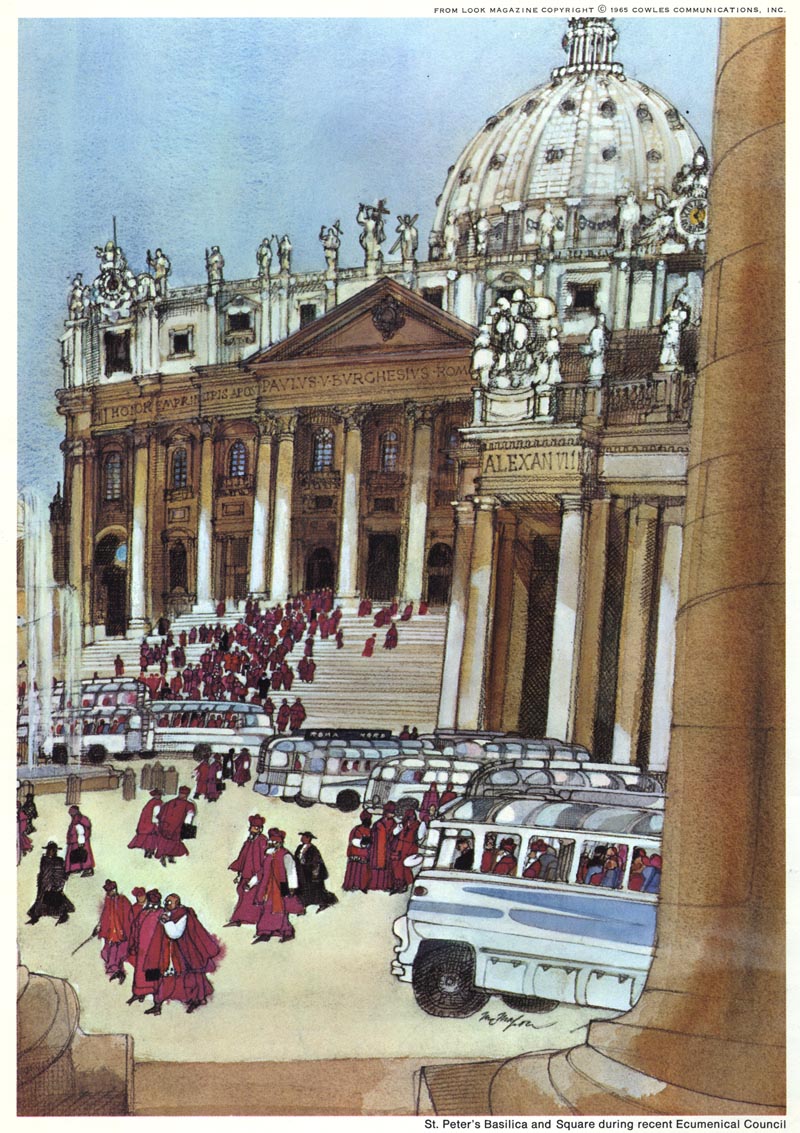
FM: When I was doing my Ecumenical series in Rome I noticed a TV set on a Doric column, suggesting the changes in the Church. I put that in the drawing, of course.

(Below: McMahon's Ecumenical series)
McMahon65

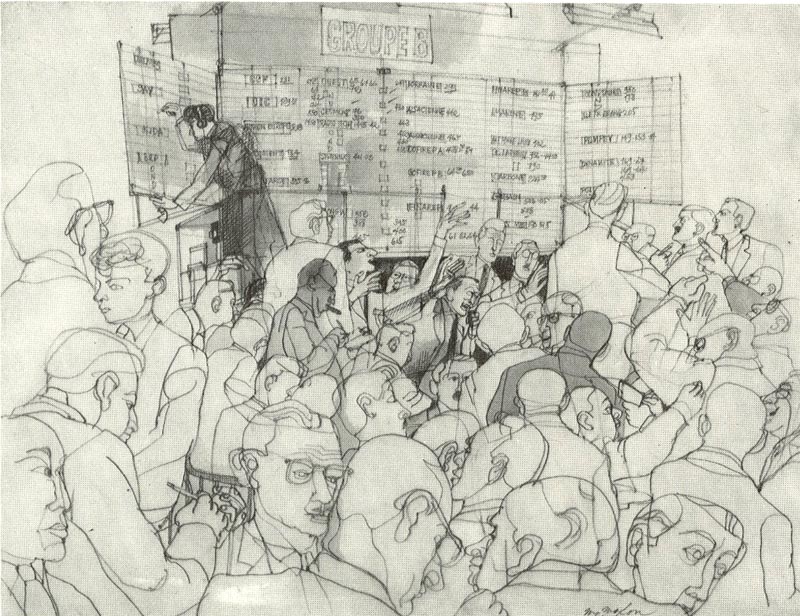
FM: When I did a meeting of Common Market officials I drew a tangle of wires which linked each delegate to his colleagues by way of the translator's booth.

McMahon63

(Above and below: two pieces from McMahon's Common Market series)

McMahon64

When I drew an Asian priest I put in an electric fan right up front in the picture to show how hot it is in that part of India. What I'm trying to do is present the truth through this added dimension of seeing. Not all editors will go for that. They'll complain, "But this is interpretive!" And of course it is. But I think you can convey more "truth" this way than you can with photographs.

Take the drawing I did of a Japanese family in the living room of their home. The room has the traditional tatami floor, but a television set I noticed there suggets to me that even in a traditional, tightly structured Japanese family there is awareness of the outside world.

McMahon42

When I did a drawing of Adlai Stevenson I showed him as a private man, sitting at a cluttered desk. Books filled the wall behind him and nearby were pictures of his children and Abraham Lincoln. I was interested in Stevenson the thinking man. This is the way I saw him, alone and thoughtful, among things he loved. A photograph might have recorded the scene, but the details could not have been given the same emphasis.

* Concluded tomorrow

* Many thanks to Matt Dicke, who provide all the material for today's post.

Tuesday, February 12, 2013

The Franklin McMahon Interview, Part 1

The Spring 1968 issue of Famous Artists Magazine contains an interview with Franklin McMahon.  Here's a transcription of that conversation...

McMahon48

FAS: If you could make just one point about your philosophy of illustration, what would it be?

FM: I would say the important thing is that the artist should get out of the studio and look around. He should pick something that interests him. Your chance to interact with a subject increases then. It is my idea that the artist drawing directly at the site experiences an interaction with the subject and therefore extracts from the subject a kind of meaning that can be achieved in no other way.

McMahon40

FM: When photography became important the artist gave up and went back into the studio. It's time he got out. I also think that we are often too concerned with how a picture is done and not enough with what it has to say. The surface, the wash, light, dark, seem more important than what's in the picture. Technique is not so important as content.

McMahon39

FAS: Could you tell us a little bit about your work materials? Then we can dispense with technique for the rest of the interview.

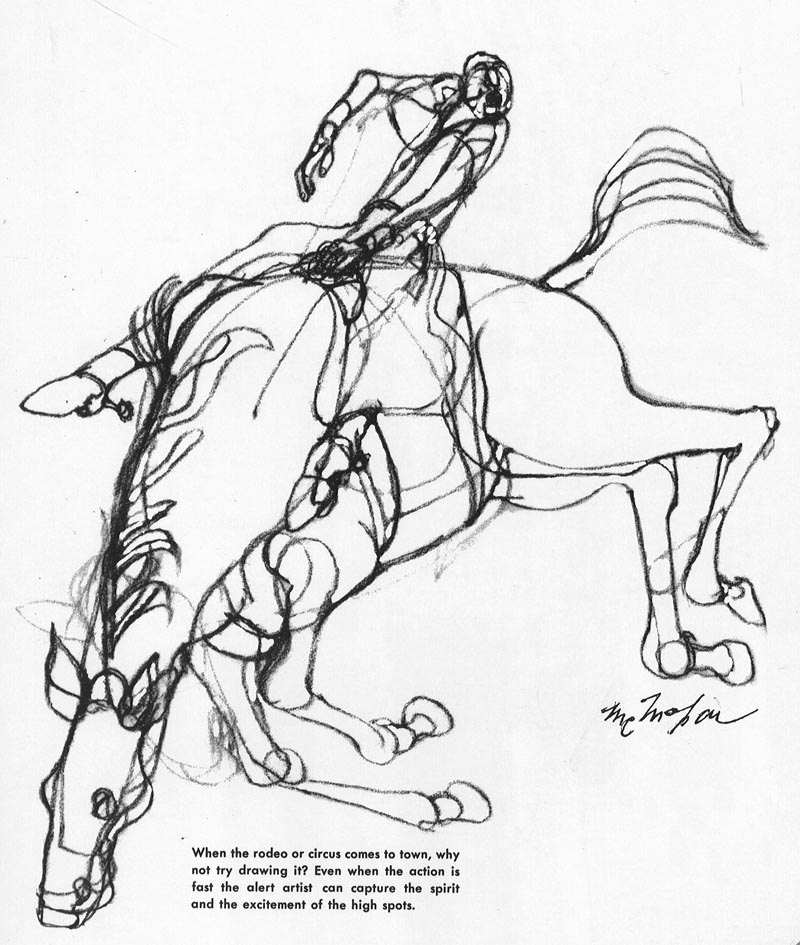
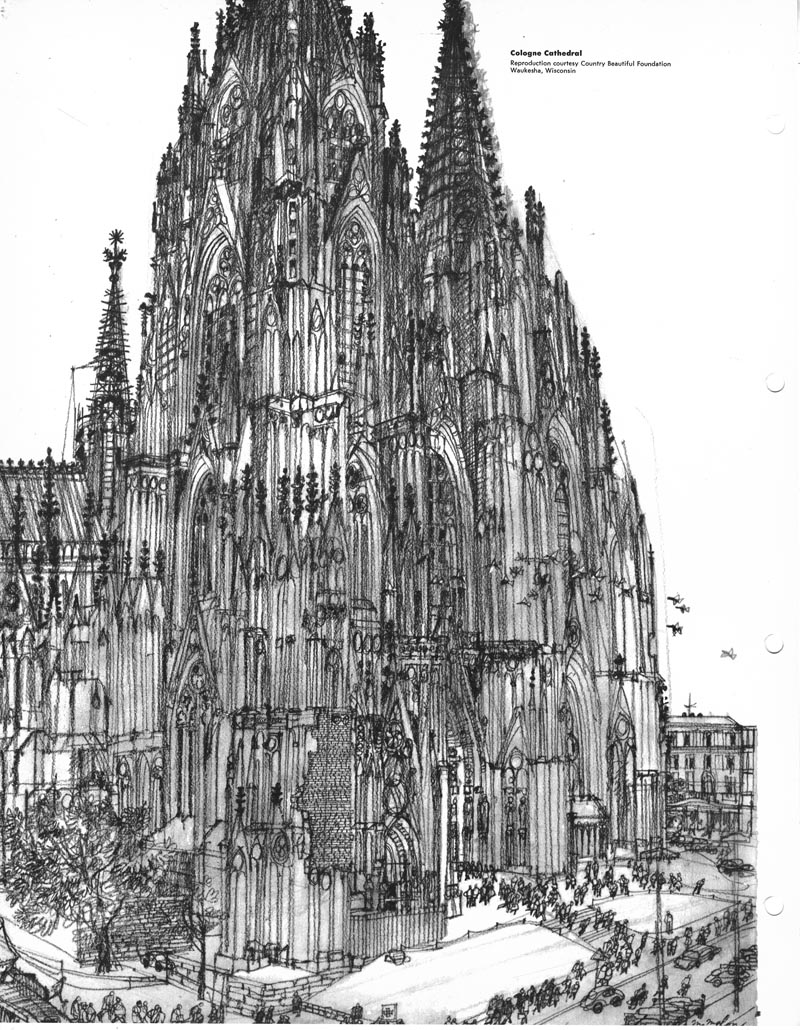
FM: I work mostly in pencil, a Veriblack 315, which has a thick, soft graphite, and with charcoal pencil, which is just like an ordinary pencil except that it has a core of charcoal instead of graphite. I carry a bunch of these pencils in my pocket and I sharpen them with a razor blade. My paper comes in big white pads, 14 by 17 inches for small subjects like portraits and 22 by 30 inches for big scenes like the Cologne cathedral. You need a portable means of working. You wouldn't carry an easel out on my kind of job.

McMahon45

FAS: When you were showing your on-the-spot drawings to the instructors one of them commented, "That's a very aggressive size." What did he mean?

FM: Most guys do small sketches and then go back to the studio and work them up. I draw reproduction size when I go out. When you start a picture you don't know how it is going to evolve, although I don't have much time to change my mind when I'm out there. I like to work all over the paper. Most artists describe the work they do in the field as sketching. However, I draw. I often do the finished art on the site. I get choked up when i do sketches for future finishes. You begin to ask yourself, will the composition be right? Will the intersecting of this and that work? I draw the broad outlines on the spot and I see the picture then. If I don't finish the picture on the scene, I have at least the bones of it to be fleshed later. I prefer to be involved in the actual event. I think you gain from that. I may complete the details later, like drawing each individual brick.

McMahon41

FM: There's no shortcut or trick to this tedious job, but I do try to make every stroke count.

FAS: How can you do such precise architectural detailing and at the same time capture the action?

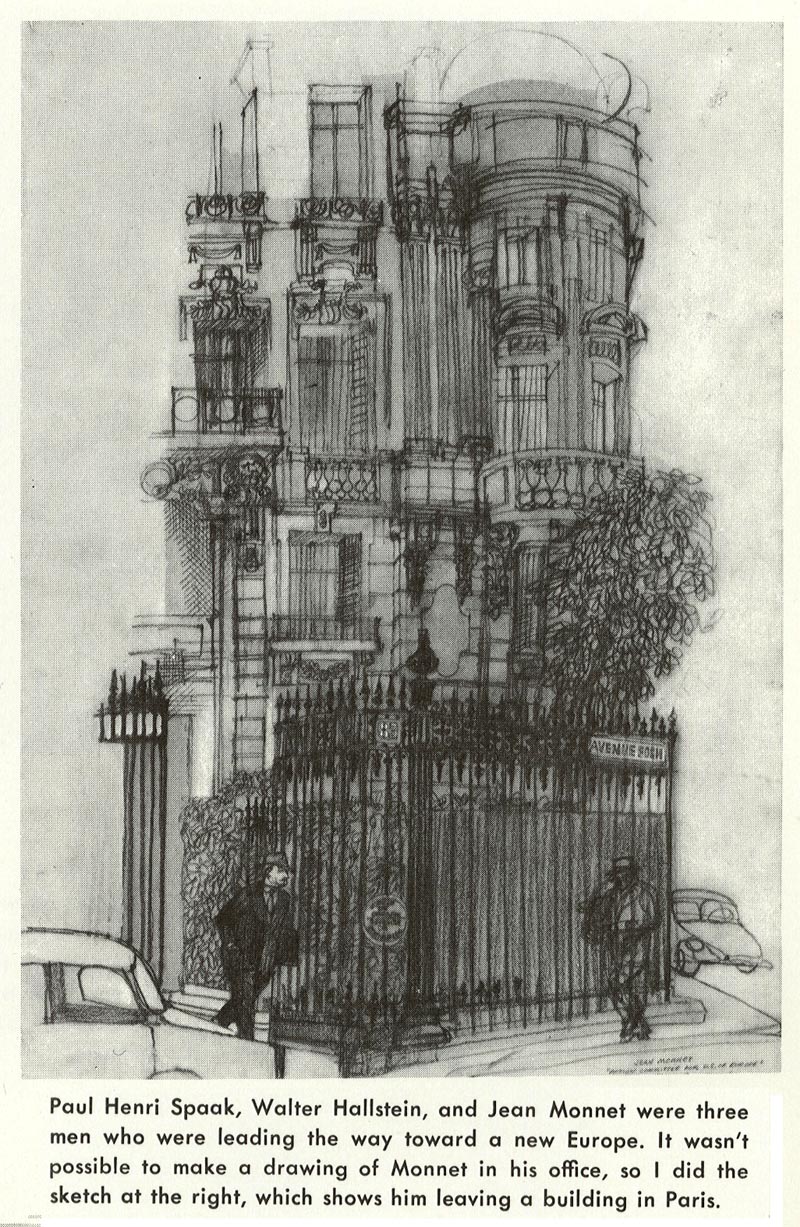
FM: For my Common Market story I made a drawing of Monnet coming out of the building, but I drew the building the day before. I had only a few seconds to catch Monnet himself.

McMahon50

FM: When I did the cardinals leaving St. Peter's I knew that St. Peter's would be there the next day so I could go back and do it. What I wanted to catch was the moment when they poured down the steps, and I did a sketch of the monument in the foreground while I waited for them to come out.

McMahon49

FAS: How long does it take you to do one of these on-the-spot drawings?

FM: it all depends on the subject. When I drew the Archbishop of Tokyo I made several quick sketches while he preached one sermon. It probably took no more than five minutes. My drawing of Catholic dignitaries meeting in St. Peter's took half a day.

McMahon20

FAS: Sometimes when you turn in a job you include notes on the subject matter of the sketches. How do you have time to research a story and make drawings too?

FM: I make notes right on the drawing paper when the subject says something that interests me. or, I make notes later so I won't forget. My wife is very helpful while I'm making a drawing. Sometimes she goes with me on trips. She can find out lots of things just by going around to shops, buying bread and cheese. I provide long-winded captions, full of details. I try to get the spirit of the scene into my words just as I try to do in my pictures. The editors then distill my story to fit the space.

McMahon51

* Continued tomorrow

* Many thanks to Matt Dicke, who provide all the material for today's post.

Monday, February 11, 2013

Franklin McMahon: Artistry from Mundanity

The term "reportage illustrator" tends to bring to mind courtroom reporting, so it's not surprising that Franklin McMahon documented many famous moments in modern courtroom history.

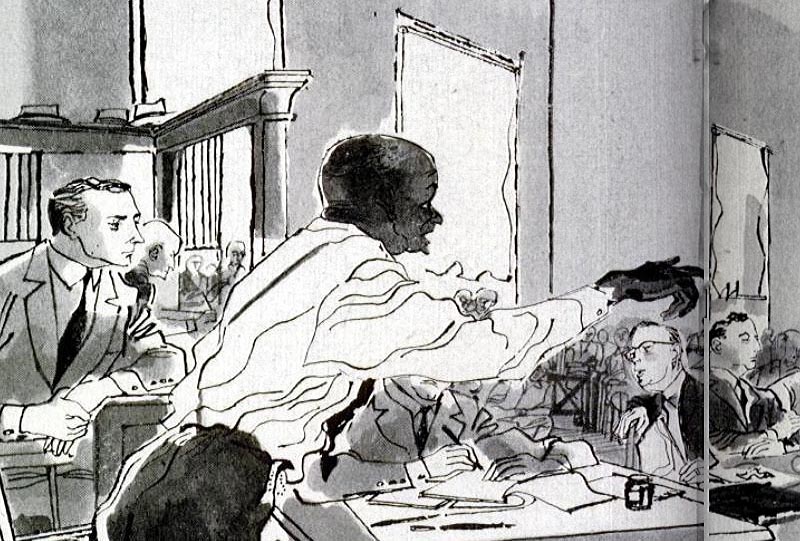
In September 1955, on assignment in from Life magazine, McMahon was present at the trial of the killers of Emmett Till, a black 14-year-old boy from Chicago who was brutally murdered for flirting with a white woman; the young wife of a grocery store owner.

McMahon34

McMahon captured an important moment - many say a turning point - in civil rights history. When Till's uncle, Moses Wright, stood and pointed out the two murderers, it was the first time in the history of the state of Mississipi that a black man implicated the guilt of a white man in court.

McMahon34.detail01

During his storied career, McMahon recorded the likeness of many important historical figures...

(Martin Luther King Jr.)
McMahon33

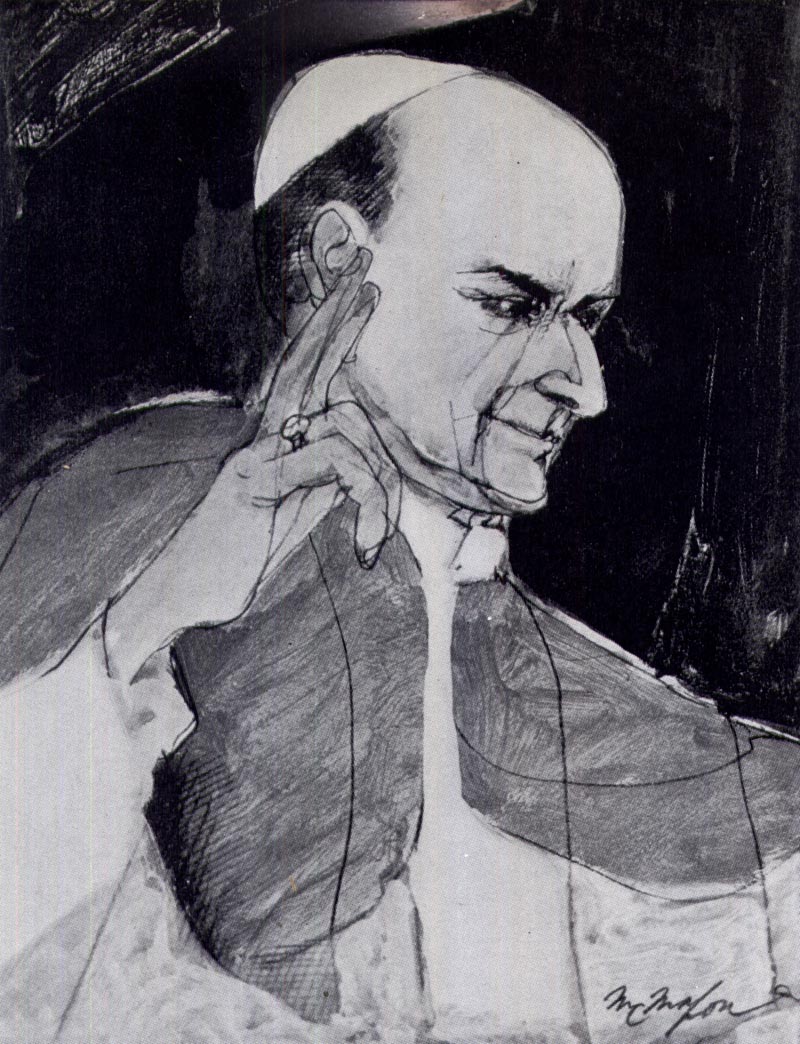
(Pope Paul VI)
McMahon18

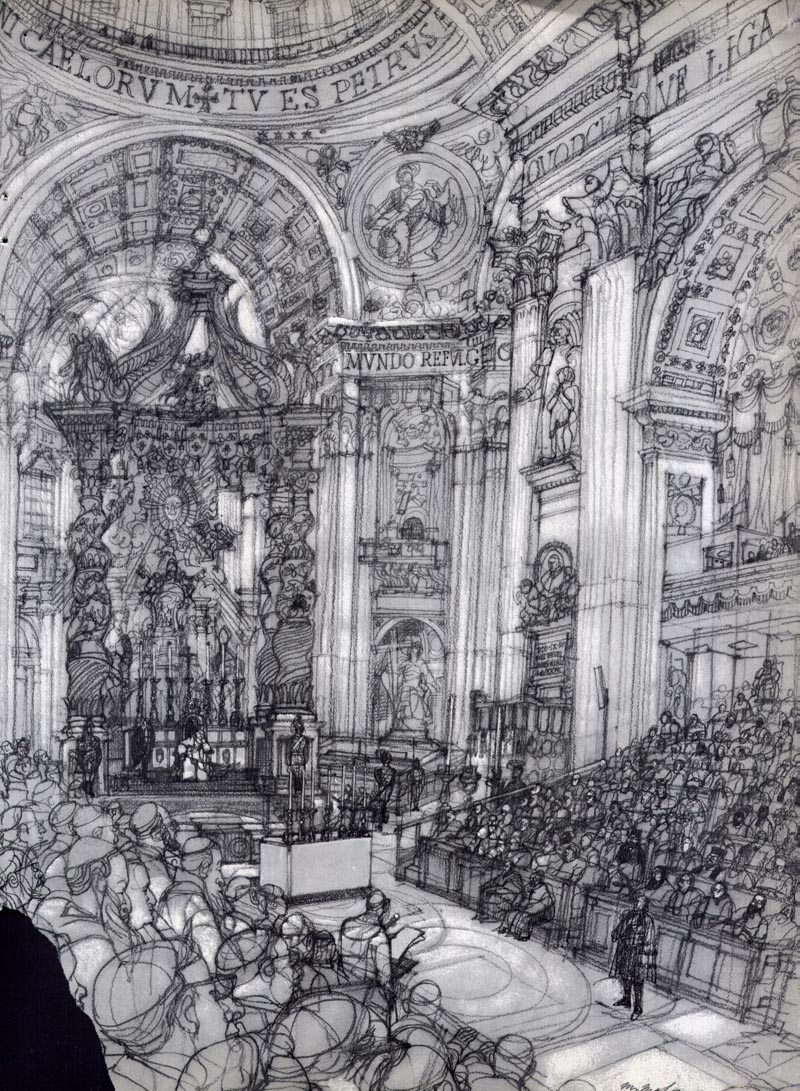
... and the range of subjects he documented and the assignments he undertook is truly unprecedented. Here's a drawing of St. Peter's Basilica that was printed in the Saturday Evening Post and the Chicago Tribune...

McMahon21

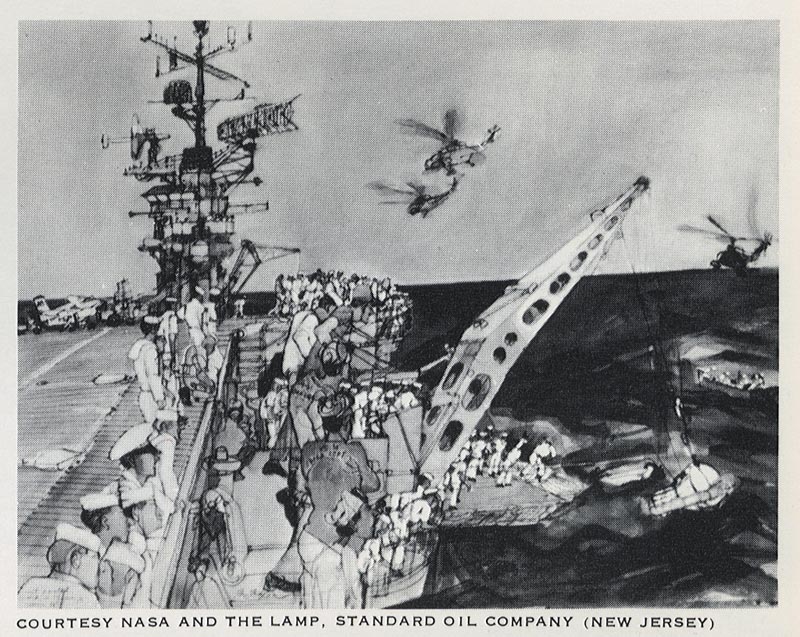
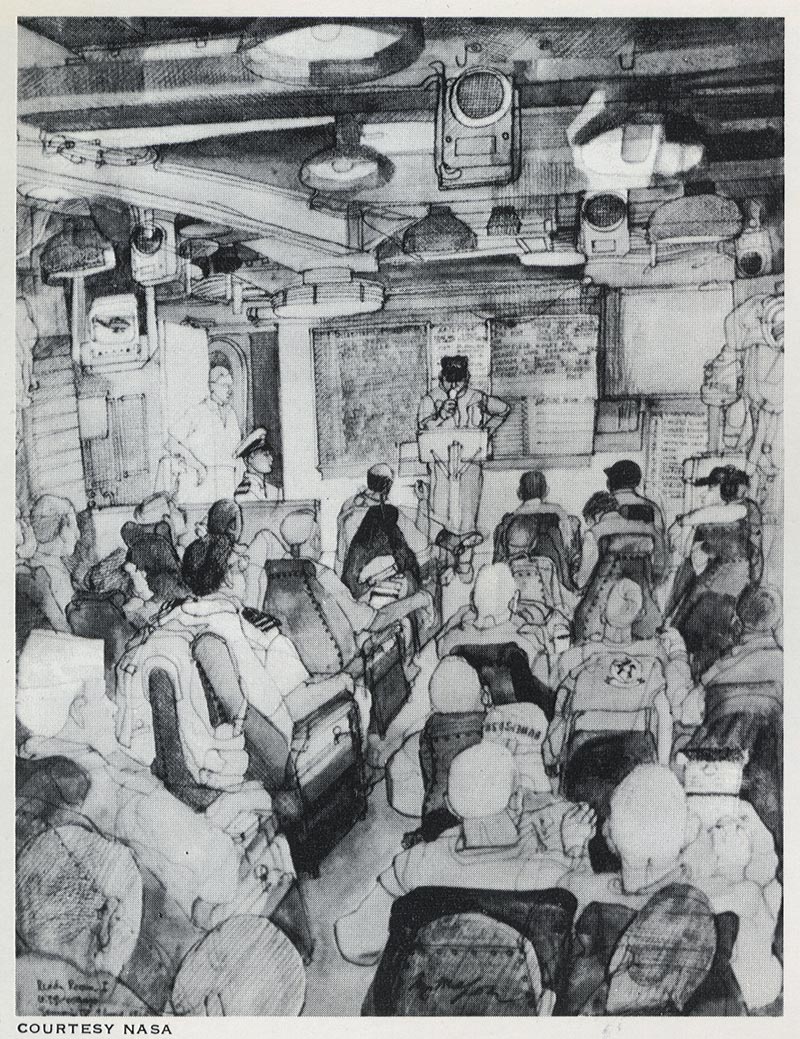
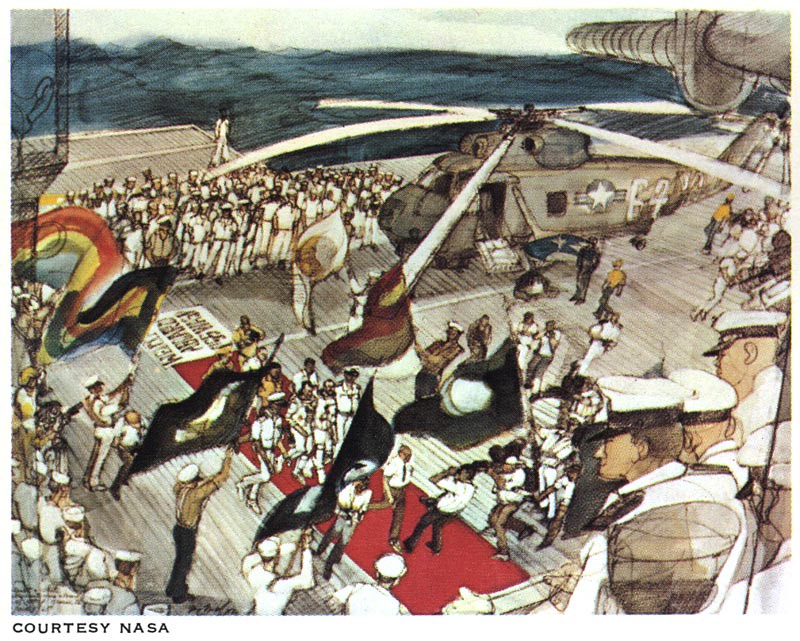
... and here's one from a series done on board the U.S.S. Wasp during the recovery of the Gemini IV space capsule.

McMahon38

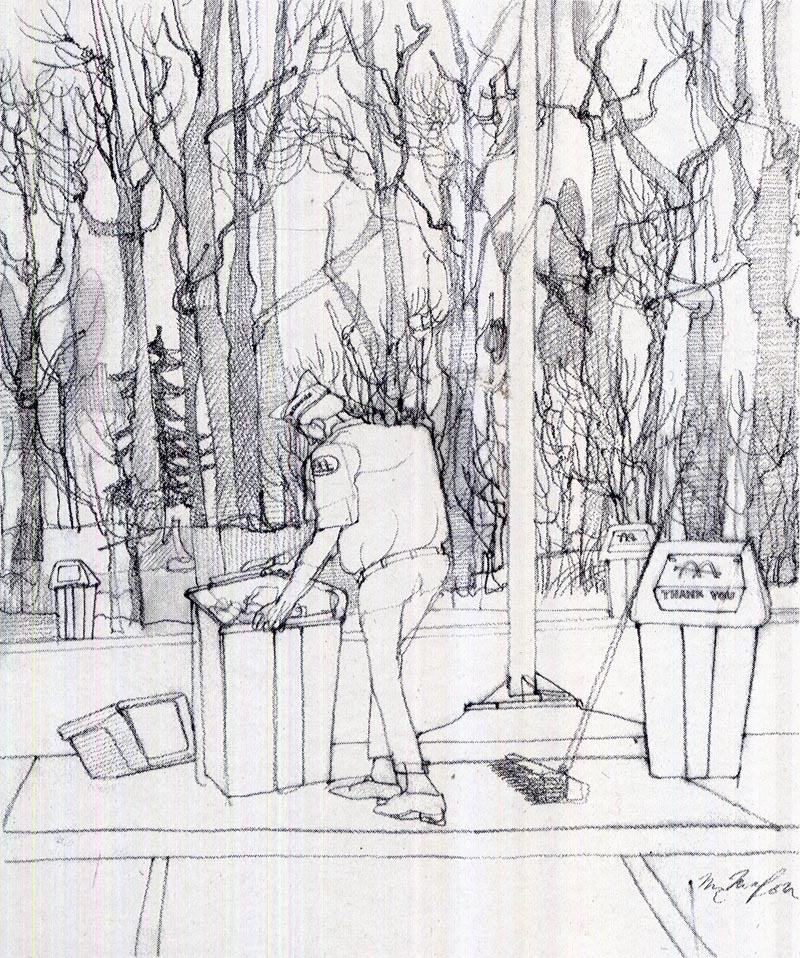
By their very nature, readers would find these subjects compelling, but even McMahon's illustrations of ordinary people living everyday lives provide the viewer with something remarkable: the sensitivity of his observational drawings brings artistry to even the most mundane activities.

Here is an illustration by McMahon for a 1960s McDonald's Corporation annual report...

McMahon30

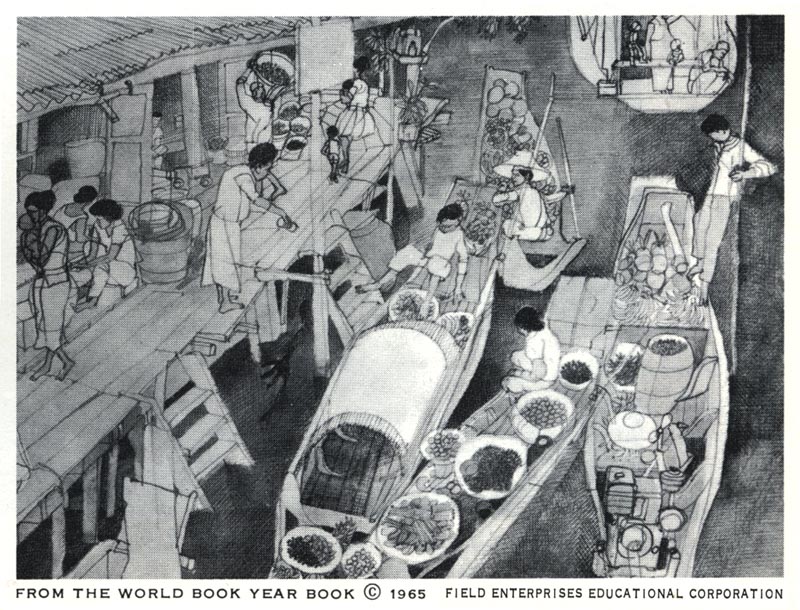
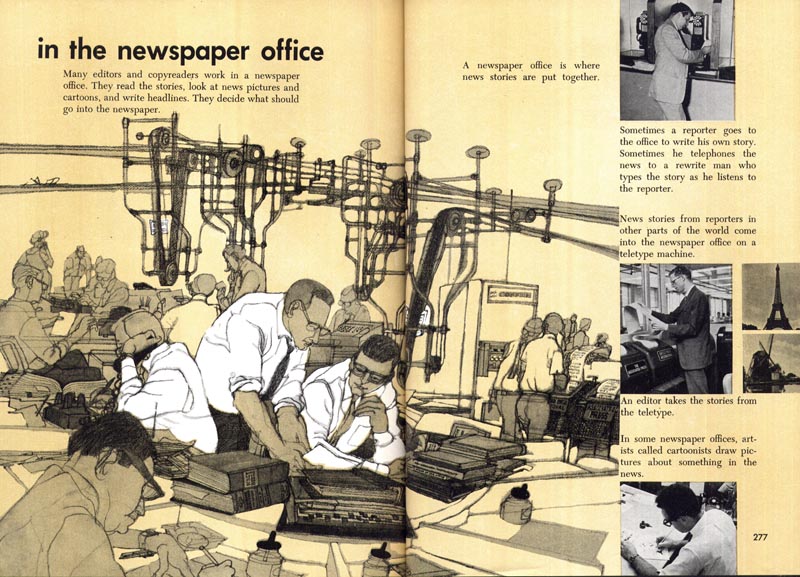
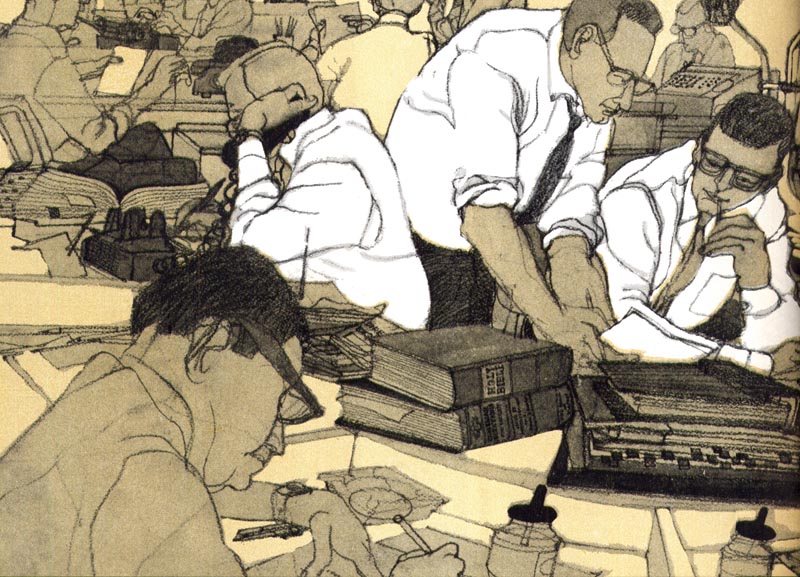
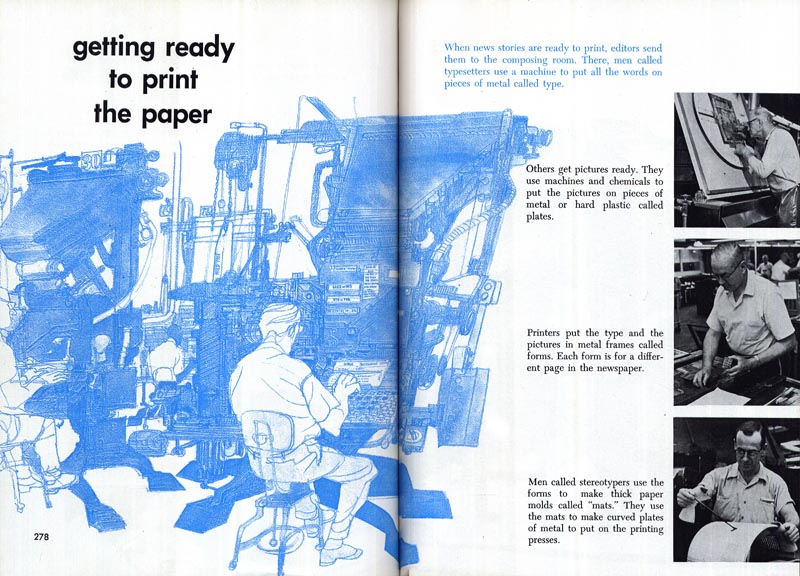
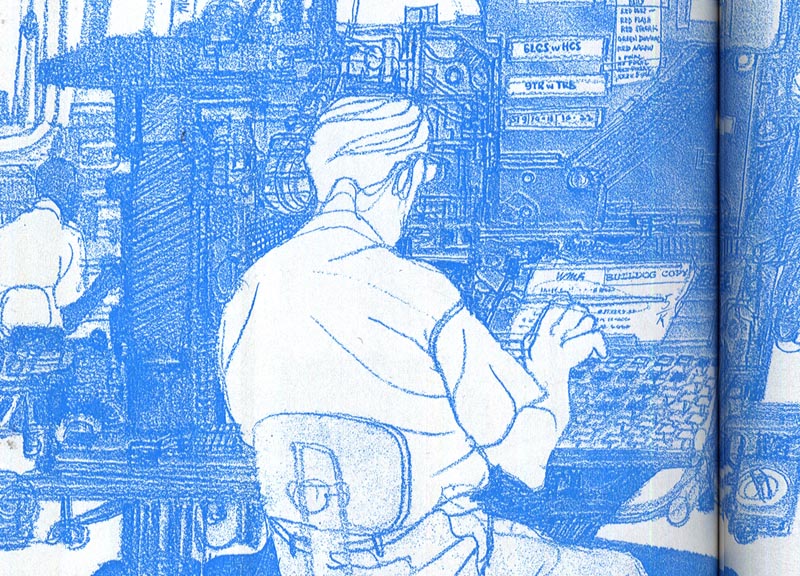
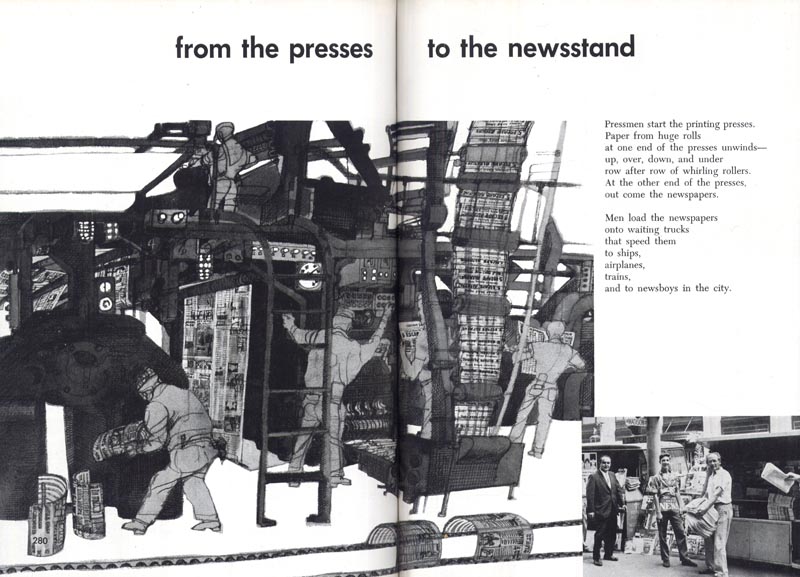
Three double page spreads on newspaper production from the 1964 edition of "Childcraft: The How and Why Library"...

McMahon26

McMahon26.detail01

McMahon27

McMahon27.detail01

McMahon28

A painting for an article in Chicago Magazine, "Housing, Fair and Otherwise," 1960s...

McMahon32

One of approximately fifty drawings for an IBM film produced by Charles Eames...

McMahon29

And here's one of my favourite Franklin McMahon illustrations among all those I've seen while researching the artist, done for an Abbott Laboratories publication called "What's New."

McMahon31

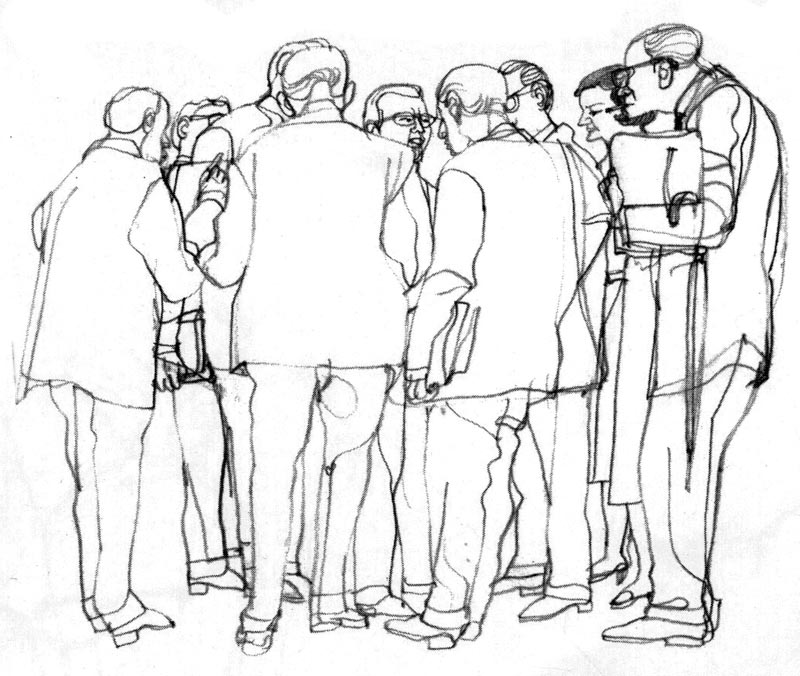
McMahon once said, "I tell students: Look at the people you see on the way to school. Draw them. Look at the people in a bus station, waiting for a train. Draw them. Go to the airline terminal. Go to the courtroom, factory, municipal government. It doesn't have to be reportage in the sense of an incident. Draw what you see."