Showing posts with label Joe Bowler. Show all posts

Thursday, January 24, 2013

Joe Bowler Interview, Part 6: From Illustration to Portrait Painting.

Last week, in Parts 1, 2 and 3 of this interview, Joe described the early years of his life, the beginning of his professional career, and his days at the Charles E. Cooper studio. In Part 4 and Part 5 we discussed some of Joe's major influences and his art process. In this concluding instalment of my interview with Joe Bowler, the artist talks about shifting gears from commercial art to portrait painting... ~ Leif Peng


LP: You mentioned that, because you'd worked for Collier's, you really weren't allowed to work for the Saturday Evening Post - that there was a sort of unwritten rule. So after Collier's folded, (SEP Art Director) Frank Kilker finally began giving you work...

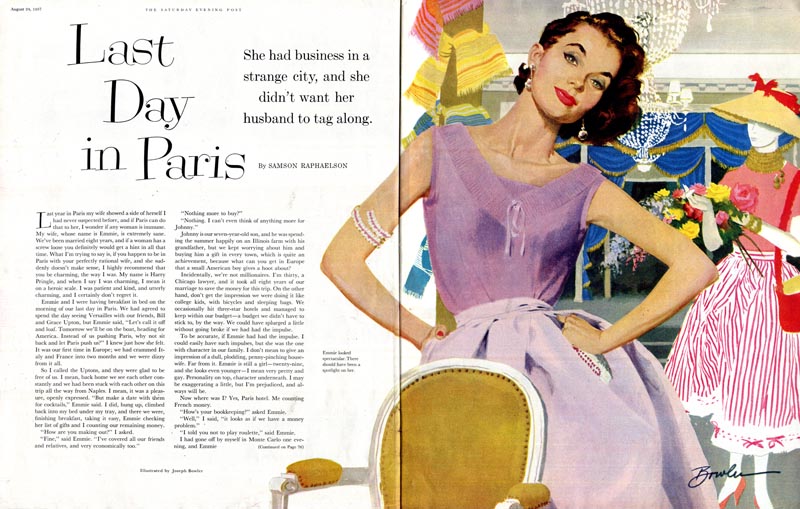
(Below, Joe Bowler's first illustration for the SEP, August 1957)
Bowler67

JB: (Joe chuckles) Yeah... Kilker was a great character. He'd come over every Friday with his little briefcase with a whole bunch of scripts in it. And we'd all go out to lunch and get bombed - they were all martini drinkers - and then he'd pass out these scripts for Coby and Joe and when I could finally get with them, I'd get mine (he chuckles again). These scripts always had a little yellow typewritten paper that gave you the sentence - the actual sentence - that was to be illustrated. And that was it!

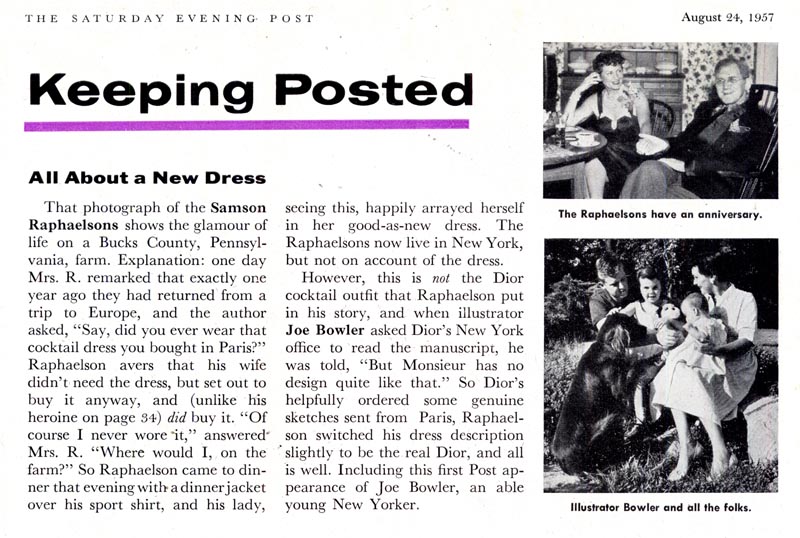
(Below, from the back page of that same issue, a photo of Joe and his family and a mention that this is the first appearance of Joe Bowler, "an able young New Yorker.")
Bowler68.sm

JB: There wasn't any of this reading the script and finding out for yourself, which was how it was most of the time. At the Post they really wanted this particular thing in the magazine. So you did it.

LP: So that wasn't typical of other magazines?

JB: No. Most of the time they'd give you the script and you'd read it and - in the end, I don't think they even talked to me about it. They'd just give me a script and I knew what they wanted.

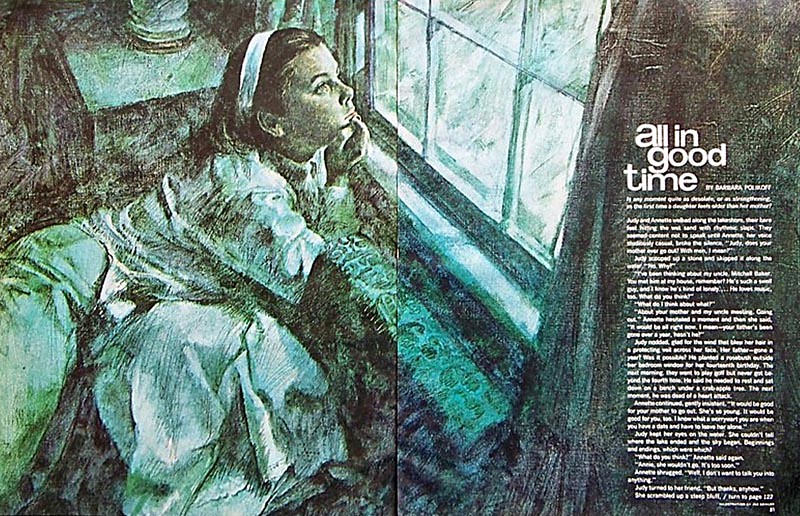
(Below, Joe Bowler DPS from Redbook, October 1961)
Bowler48

JB: If it was anything that was a little off my regular thing I would do some studies and show them, but for the most part it was my choice. The Post was the only one that really got very specific.

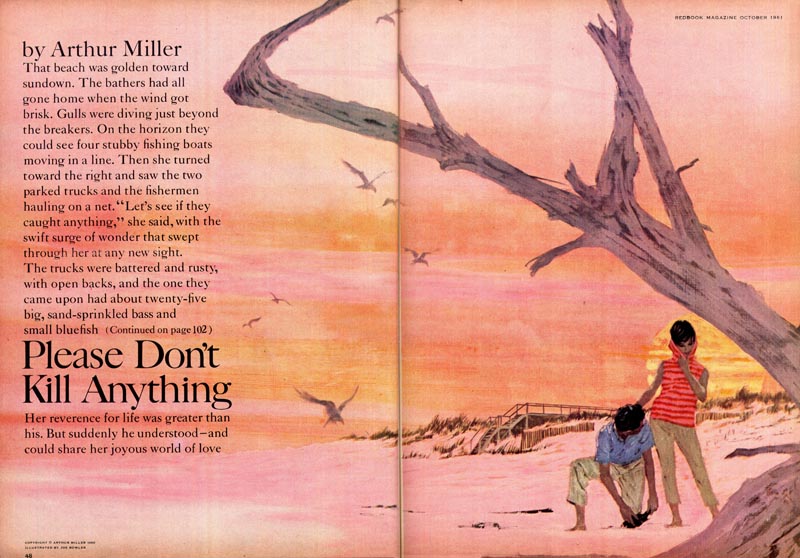
(Below, Joe Bowler DPS from Redbook, October 1961)
Bowler47

LP: Did you ever do any paperback covers?

JB: I did one or two. I think one of the art directors called and I said, "Yeah, I'll try one." But I think I only did one or two. And that was right at the end [of Joe's illustration career] so I don't remember much about it.

LP: What about movie posters? Did you ever do any of those?

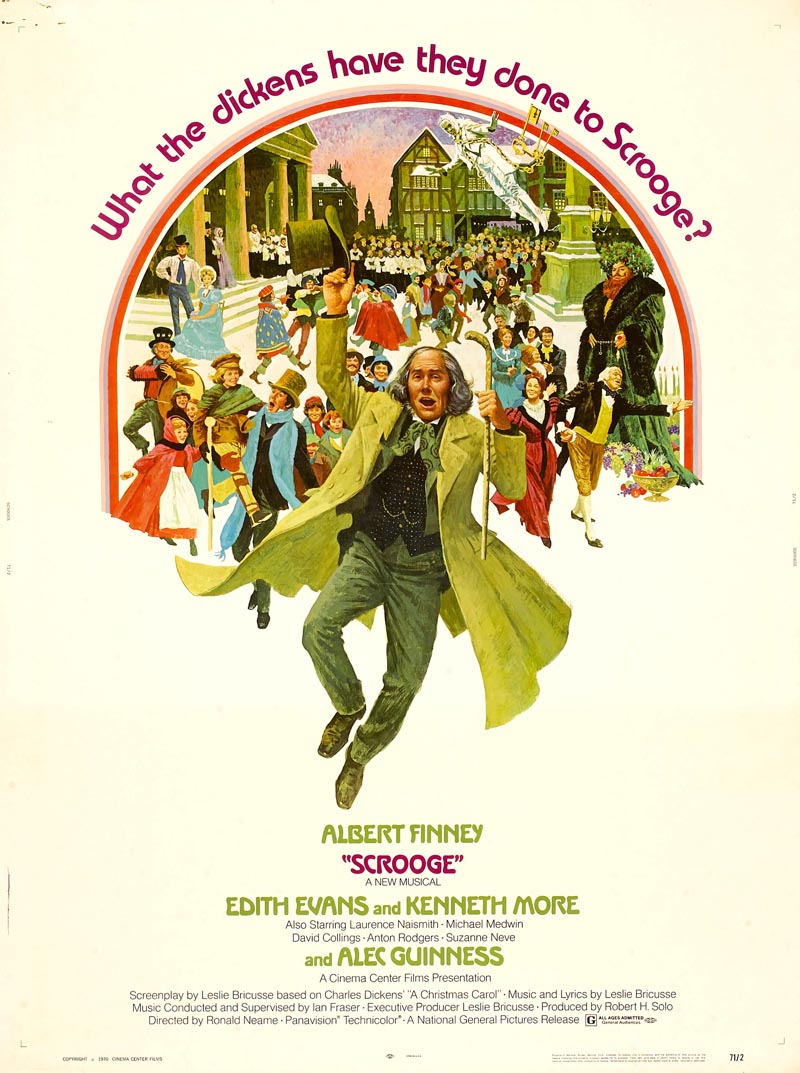
JB: Yeah. Before I came down here, Joe Mendola, who was an art rep, got ahold of me and talked me into him representing me. He said, "Oh, you'll make a million bucks on these Hollywood studio movie posters." So I said, "Ok, I'd like a million bucks." And I started to do one and I'll tell you, you really had to do two or three major comprehensives - which means "finished paintings", practically - and even then they would say "No, I don't like this, I don't like that." So very rarely did I make any money on those.

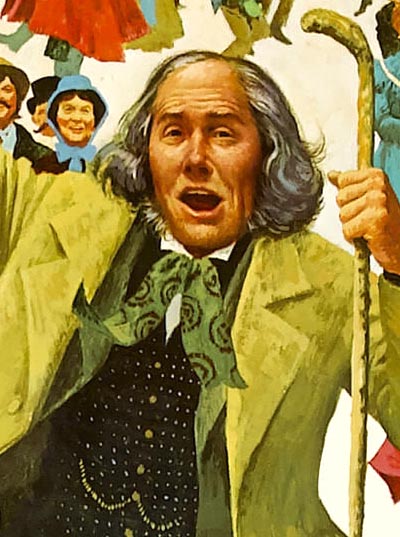
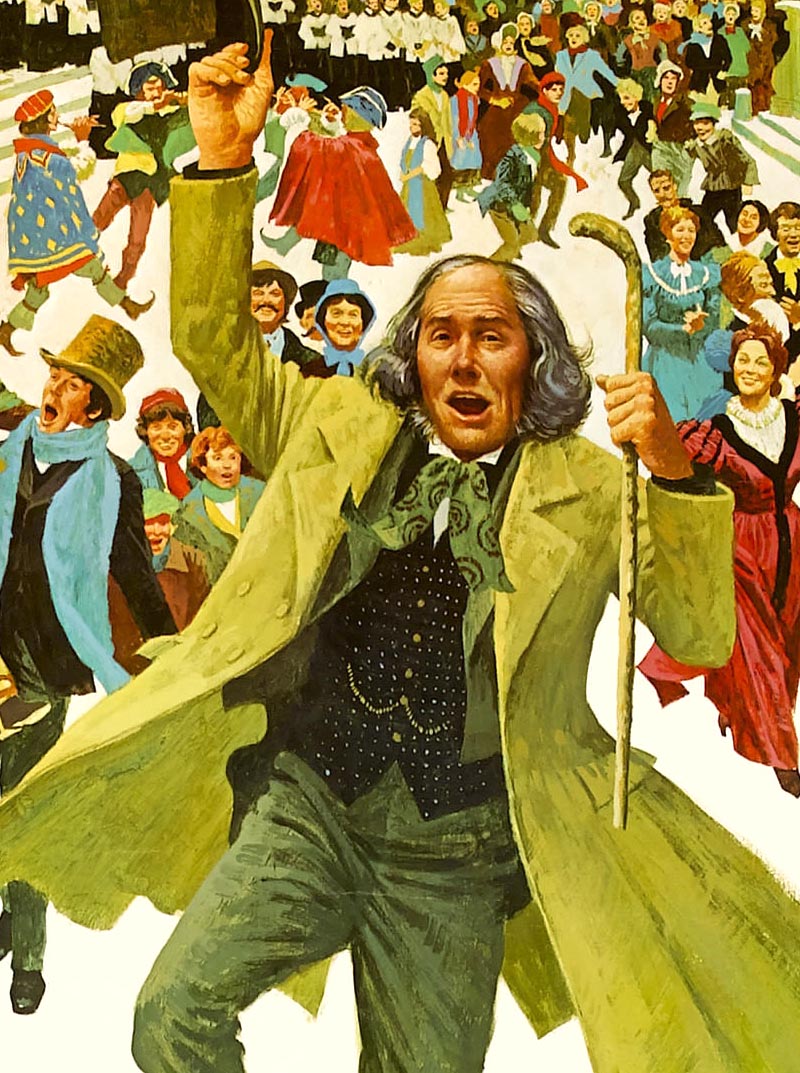
I remember they wanted me to do "Scrooge" and they said "But we want to do it differently; we want to do a portrait of Scrooge coming right at you."
Bowler70.detail02

So I got all excited about doing this painting of Scrooge. So I painted a study, and they had a big long conversation about it, and I told Mendola, "They're not gonna buy this thing. They're gonna come up with the same old crap that they always do." And they did!
Bowler70.detail01

I ended up doing this painting of Scrooge with the whole damn town dancing around him - oh, it was just terrible! (We both laugh)
Bowler70

JB: That's one of the reasons I came south, because really, nothing, nothing Joe Mendola promised would happen came true. And of course he was the type of guy who would say, "Oh, you can just knock this out, Joe. Just knock this out." Until finally Marilyn said to him (emphatically) "Joe does not knock anything out!"

(We both laugh)

LP: Now, you talk about moving south, and certainly a lot of illustrators were doing that - moving to the south west and getting into doing cowboy paintings, western art. Guys like Frank McCarthy, Ken Riley, Howard Terpning... did you ever consider doing that?

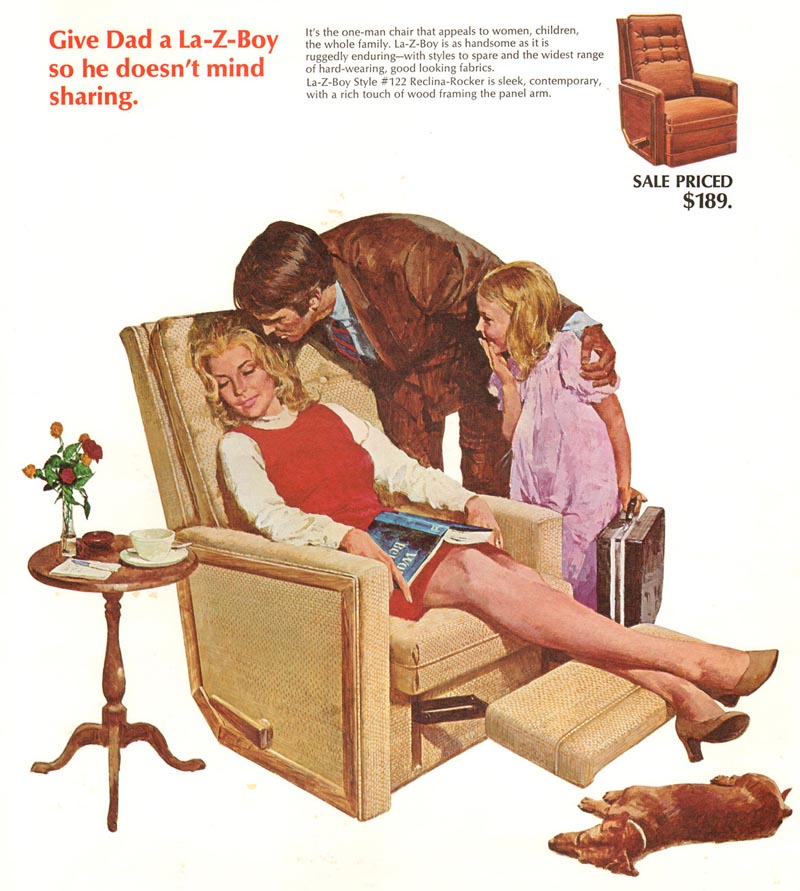
JB: No. No. I had taken on a big account; twenty-one paintings for La-Z-Boy Chairs and I'd done fourteen, and I couldn't even stomach the idea of doing seven more. (we both laugh) And the art director couldn't believe it, he says, "Joe, this is the biggest account any artist has had for years! What are you talking about?" So I said, "Look, if I can get somebody to do the other seven of these that you'll ok, would you feel better?" So not knowing him personally, but knowing who he was, I called Howard Terpning! I said, "Howard, it's Joe Bowler. I've done fourteen of these ads and there are seven more and I've taken most of the photographs, so how would you like that?" Well, (Joe chuckles) I don't think I'd hung up the phone and he was pulling into my driveway. So I gave him those seven paintings, which he did a great job on. And it wasn't more than a year that I was down south and not much longer that he was out west.

(Below, Howard Terpning illustration for a La-Z-Boy ad, 1971)
Terpning16

LP: So was that basically the end of your commercial art career? Around the early '70s?

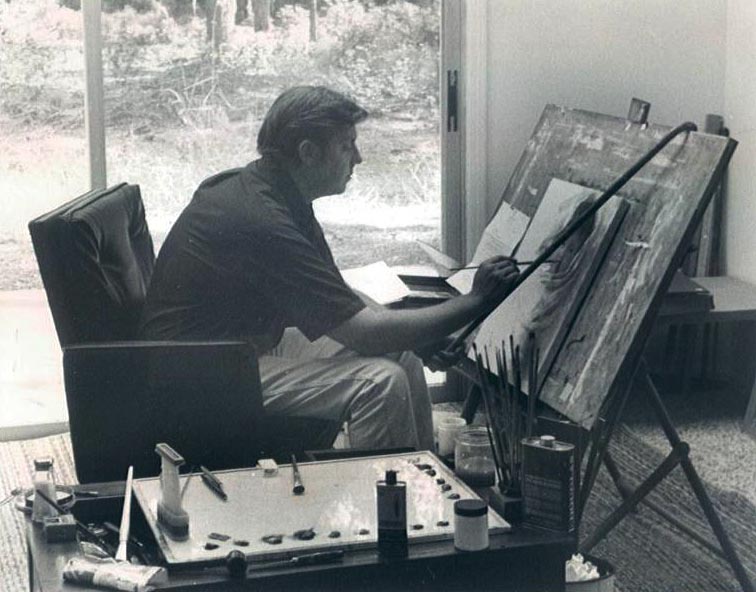
JB: Well, what happened was, Good Housekeeping was always after me. And I started to get these portraits, and the portraits were paying a lot more than illustrations.

(Below, Joe painting a portrait in his Hilton Head Island studio, 1973)
Bowler84

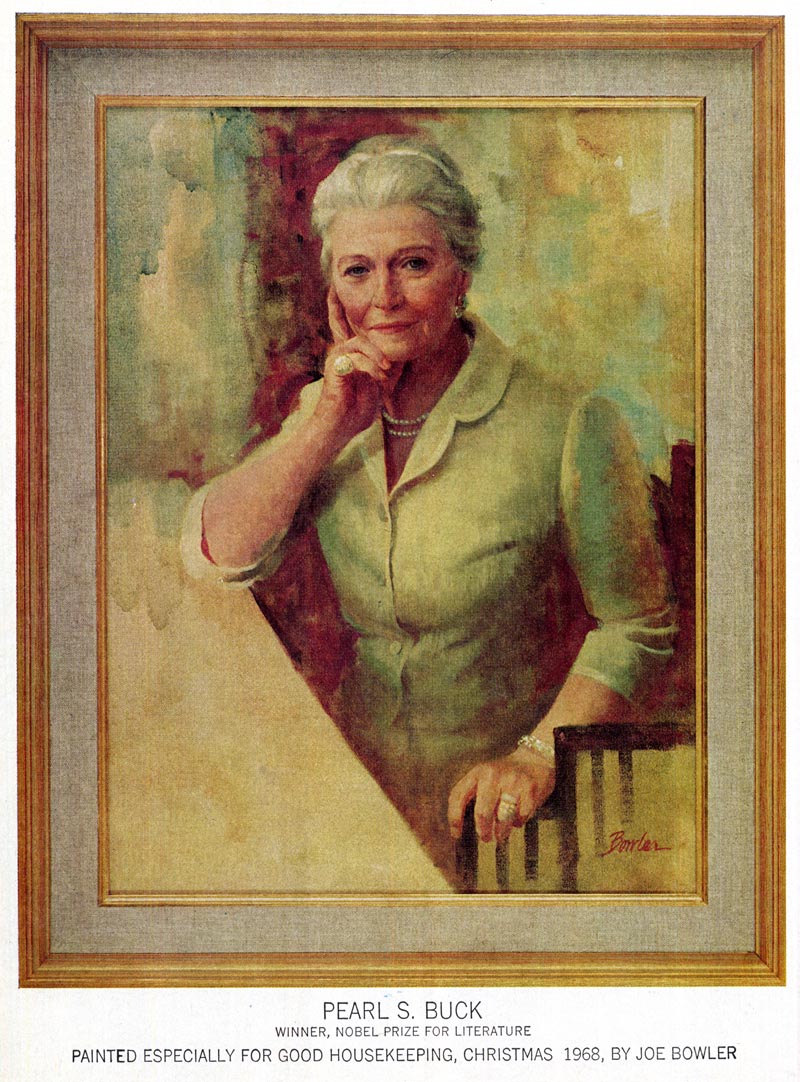
And I told the art director that I couldn't do them (illustrations), but I could send pictures of these portraits. So all through the '70s, I would do a portrait of a child and send an Ektachrome to Good Housekeeping and they would use it.
Bowler62

So I was in Good Housekeeping all through the '70s and people thought I was still doing illustration, but I wasn't. I was selling the portrait originals, getting the ok from the clients, of course, and then selling the Ektachromes to Good Housekeeping.

LP: Oohh, I see.

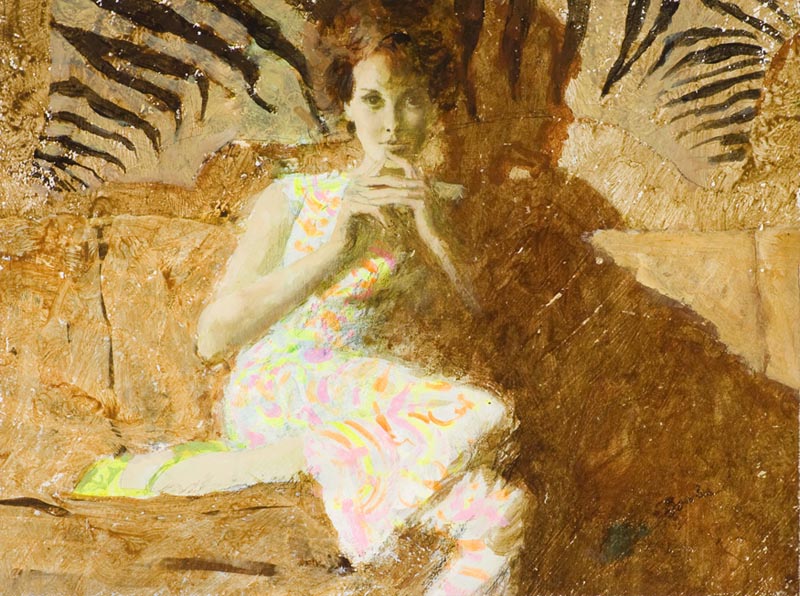
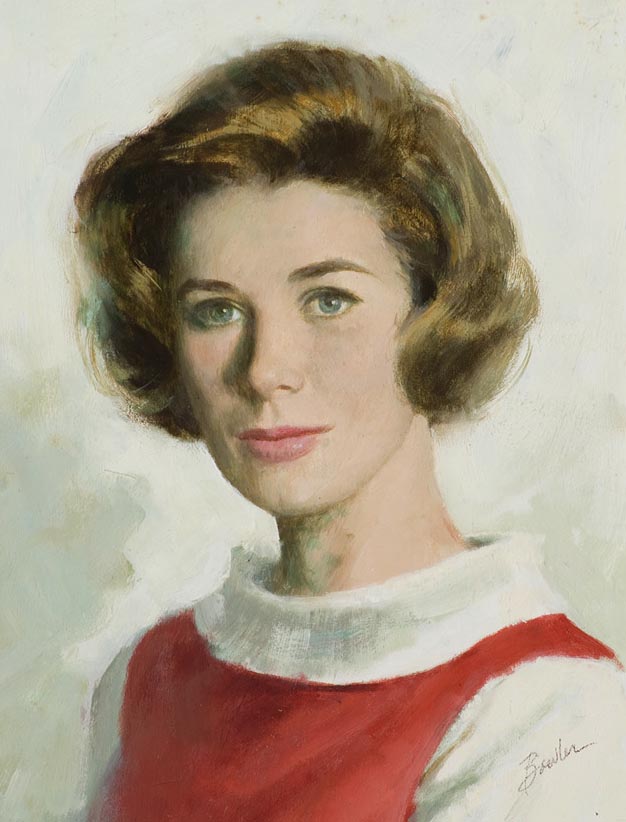
JB: In fact, one time I did this painting of just a beautiful girl's head looking right at the viewer. I actually just made her up out of several models. And at the time, Good Housekeeping had this monthly poll asking readers what they liked the best in the magazine, what made them stop and read something and how much did they read and so on. And they got the best response ever to the painting I did of that girl's head!

(Below, portrait study of Betty Crocker by Joe Bowler, year unknown)
Bowler85

JB: So from that point on, if I just had a moment I would just paint a beautiful girl's head and sell it to Good Housekeeping. And Coby [Whitmore] did the same thing and Joe [DeMers] did the same thing! And they would just buy them because they got such a good response from the readership.

(Below, a recent example of Joe Bowler's portrait paintings, 2007)

Bowler82

LP: So once you moved down south, did the portrait painting commissions come very regularly right away?

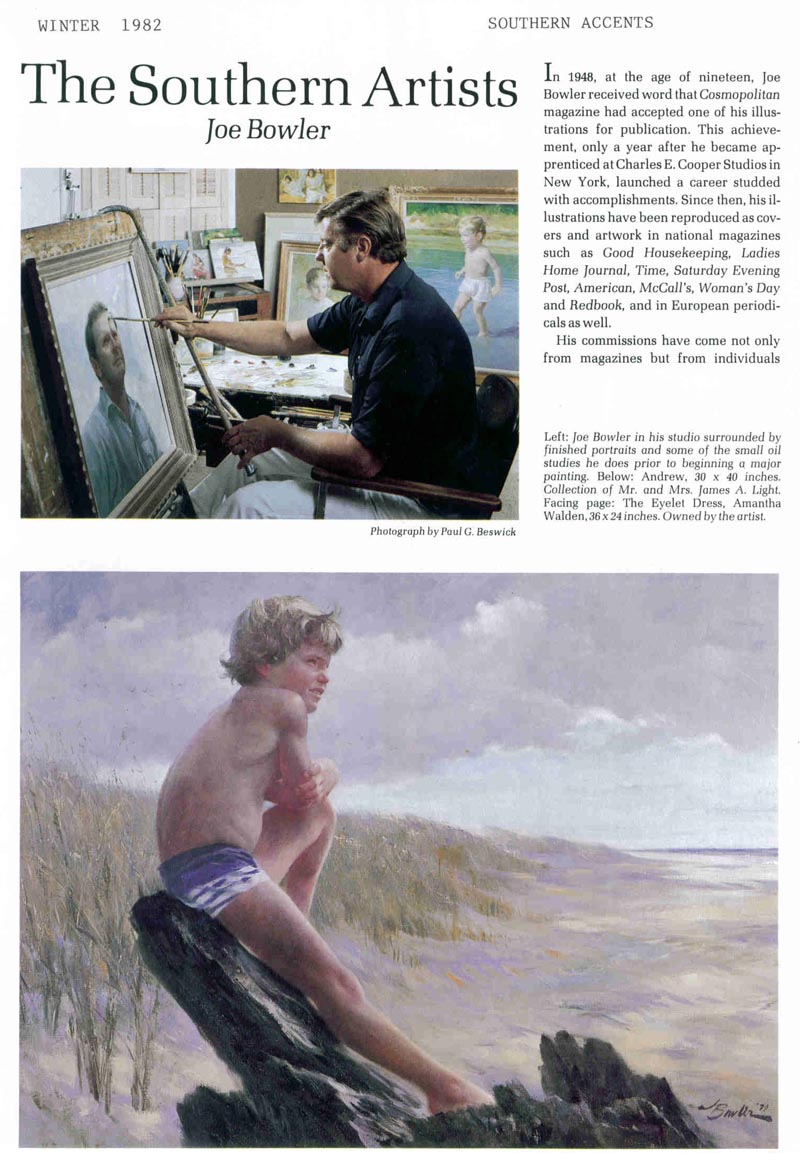
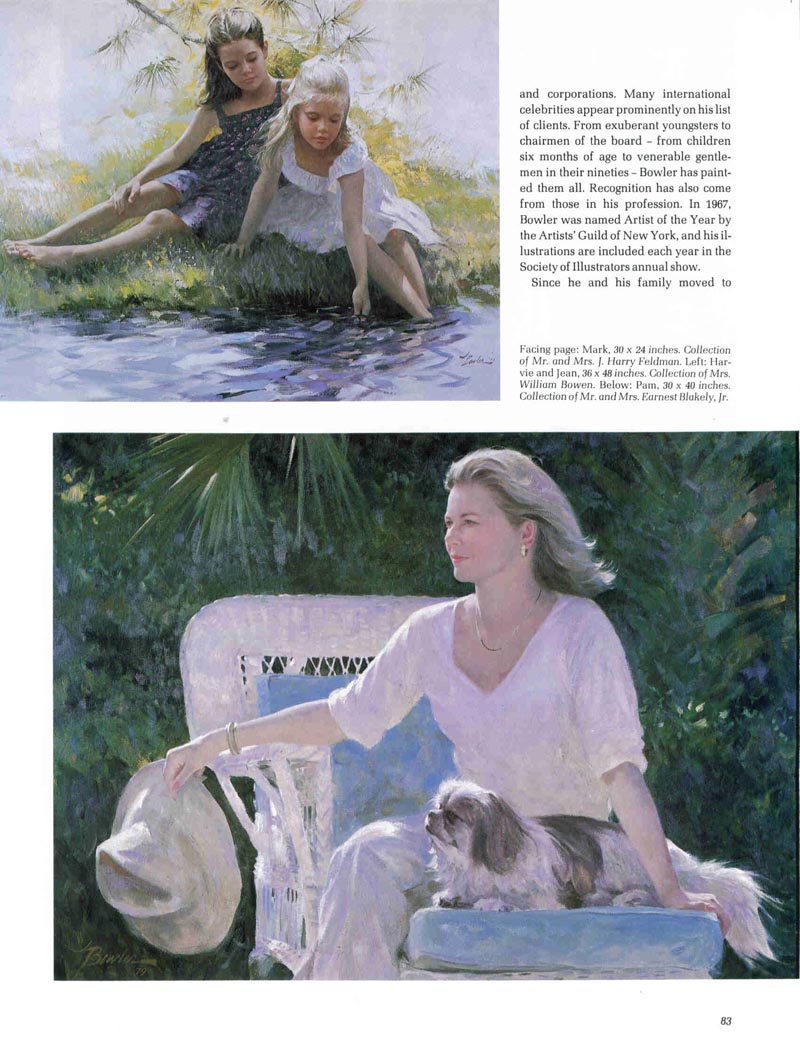
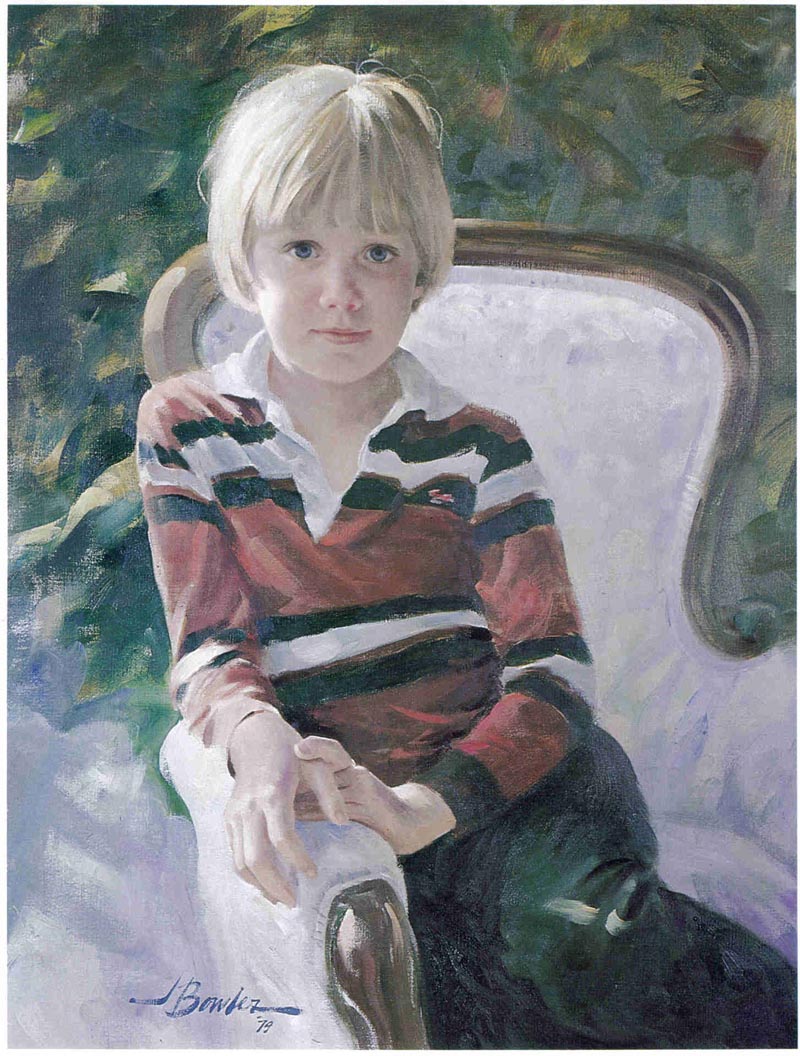
JB: Well, yeah. I had two manuscripts left over when I moved down here and once I finished those up, I was devoted entirely to going after the portrait business. Never did much advertising at all. It just seemed to happen. And then the big thing happened in the winter of 1982: there's a magazine called "Southern Accents" that was still fairly new at the time. And they had been doing a monthly article about southern artists. And a friend of mine who was Andrew Wyeth's agent got ahold of the editor and said, "You gotta put Joe's work in there." So she did. She gave me about ten pages of portraits.

(Below, four pages from the 1982 article in Southern Accents)
Bowler86

JB: Well, we got over 1,800 requests for portraits! We told the magazine after we got about 800 and they couldn't believe it.

Bowler87

JB: That magazine became the place that every portrait painter put ads in.
Bowler88

JB: And that put me in business for the rest of my life!
Bowler89

LP: Wow. Isn't that incredible. And as a matter of fact, I understand you have a client coming by this afternoon...

JB: Yeah, this is part of a family I've done for years and years. The mother of this child that I'm going to paint is a gal that I painted when she was two years old!

LP: Oh my gosh.

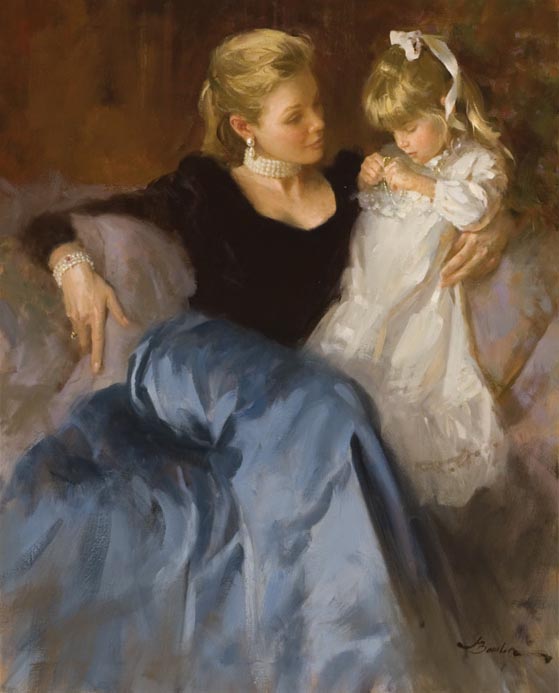
(Below, a recent example of Joe Bowler's portrait paintings, year unknown)
Bowler81

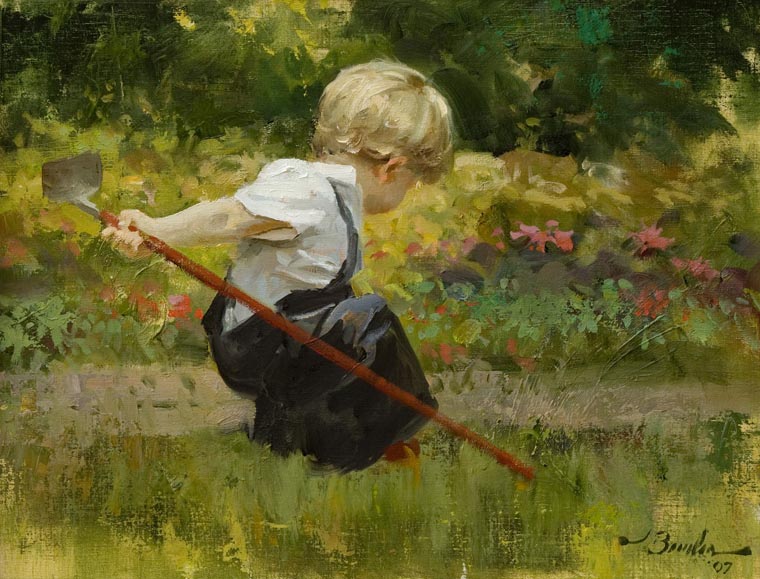
JB: And then I painted her again when she was married and had two children, so I did three of them... now this is another son and she's having that done. This is a family that has bought probably in the neighbourhood of, oh, thirty five portraits of kids. It's unbelievable.

(Below, a recent example of Joe Bowler's portrait paintings, 2007)
Bowler80

LP: It really is! I mean I knew your career had taken you into portrait painting but I really had no idea you had that kind of relationship with your clients.

JB: Oh yeah. In fact, when they get that way, I don't even call them clients - I call them patrons!

(We both laugh)

* My thanks to Joe Bowler for spending so much time talking with me - nearly four hours over two separate occasions! - to ensure all of my questions were answered. Thanks as well to Joe's daughter, Jolyn, for assisting in coordinating our schedules so her dad would be available at my convenience. If you enjoyed this interview, blame Murray Tinkelman. Murray has been gently prodding me to phone Joe Bowler for at least two years, something I kept meaning to do and putting off, and I am eternally grateful to Murray for his persistance. Thanks Murray!

* Thanks also to Lawrence Levine for providing scans of the article in Southern Accents magazine.

* To see recent works by the artist, visit Joe Bowler's website

Wednesday, January 23, 2013

Joe Bowler Interview, Part 5: More About Influences and Process

Last week, in Parts 1, 2 and 3 of this interview, Joe described the early years of his life, the beginning of his professional career, and his days at the Charles E. Cooper studio. Yesterday, in Part 4 we began discussing some of Joe's major influences and his art process. Today we delve further into that discussion... ~ Leif Peng


LP: When I read the article from American Artist magazine, 1967, you described your process as not really involving much in the way of pencil sketches. But rather, that you would do small, 8" x 10" painted sketches on gessoed masonite.

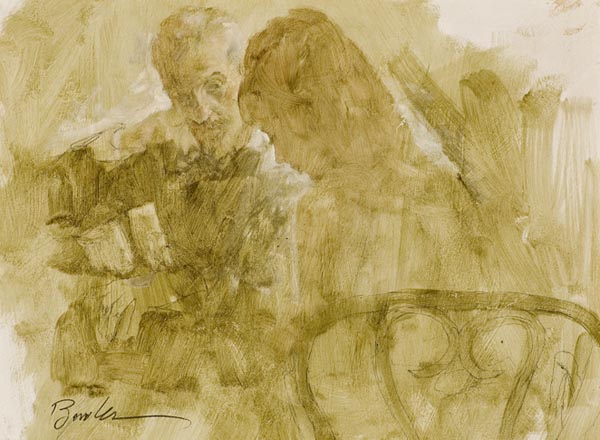
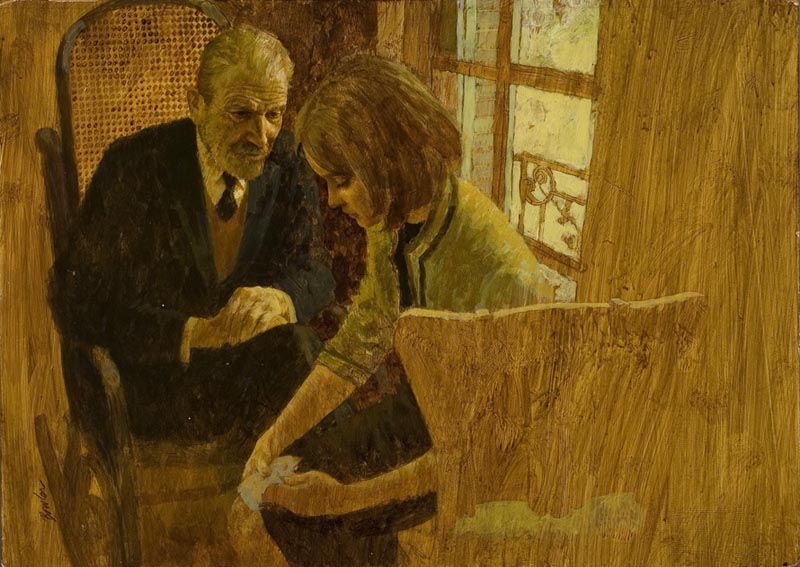
(Below, two painted sketches by Joe Bowler - studies for different magazine illustrations - 1960s)
Bowler76

JB: Yeah.

Bowler78

LP: Was that typical in the '50s as well? Or would you do a longer pencil sketch stage or a thumbnail stage before going to the paint?

JB: I changed it a little... but I would usually start with a fairly involved pencil to start with on most of the illustrations I did.

LP: I assume you'd shoot photo reference for starters...

JB: Yeah. Oh yeah. Always. But once I started doing painted sketches, I ended up drawing less and sort of 'drawing' with my paint brush. In fact, when Murray Tinkelman got me to start teaching at Parsons, that's how I would begin my demonstrations. I would just get the model up there and begin to paint... maybe do a little raw sienna outlining to sort of establish where she was going to sit on the canvas, and then go in immediately with colour and paint - big areas - like you're supposed to do.

(Below, McCall's illustration 'sketch' and final, 1960s)
Bowler72

Bowler73

LP: So you're essentially blocking in shapes and values right from the get-go.

JB: Yeah. (emphatically) I never draw anything anymore. All done with paint. And boy, is it fun. It's like making mistakes and correcting them, that's what [Thomas] Eakins used to say. And that's what I do; I just keep throwing the stuff on, scraping it off, refining it and refining it, and that's how it grows.

Bowler74

Over a period of time you start to see something really working.

Bowler75

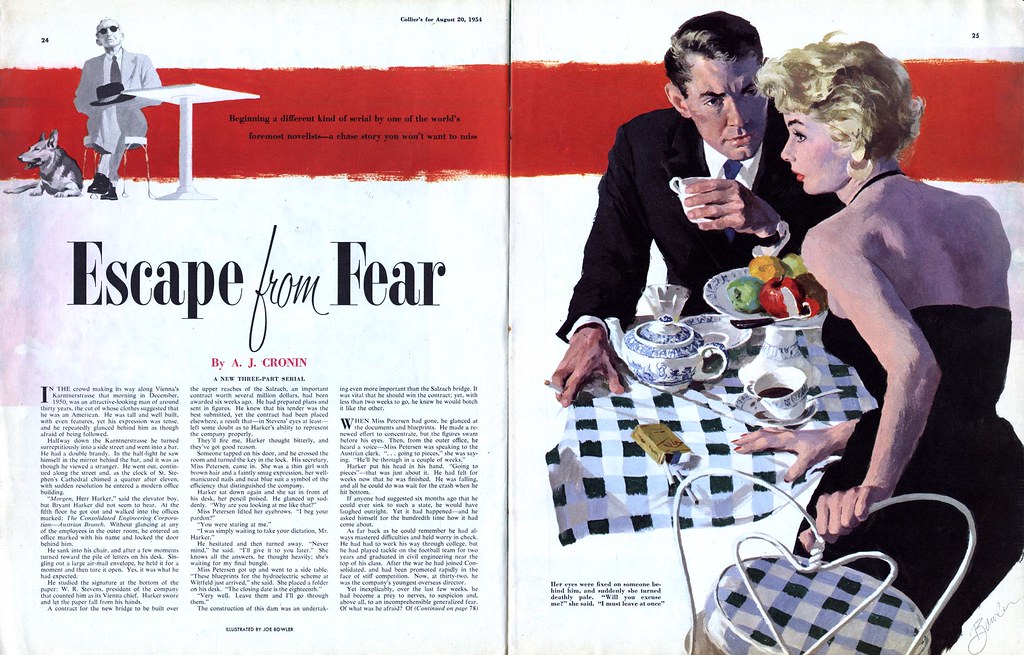
LP: Let's talk about back in the '50s... I've got this scan from one of your crime fiction pieces from Collier's. This would be from around 1954...

Bowler18.jpg

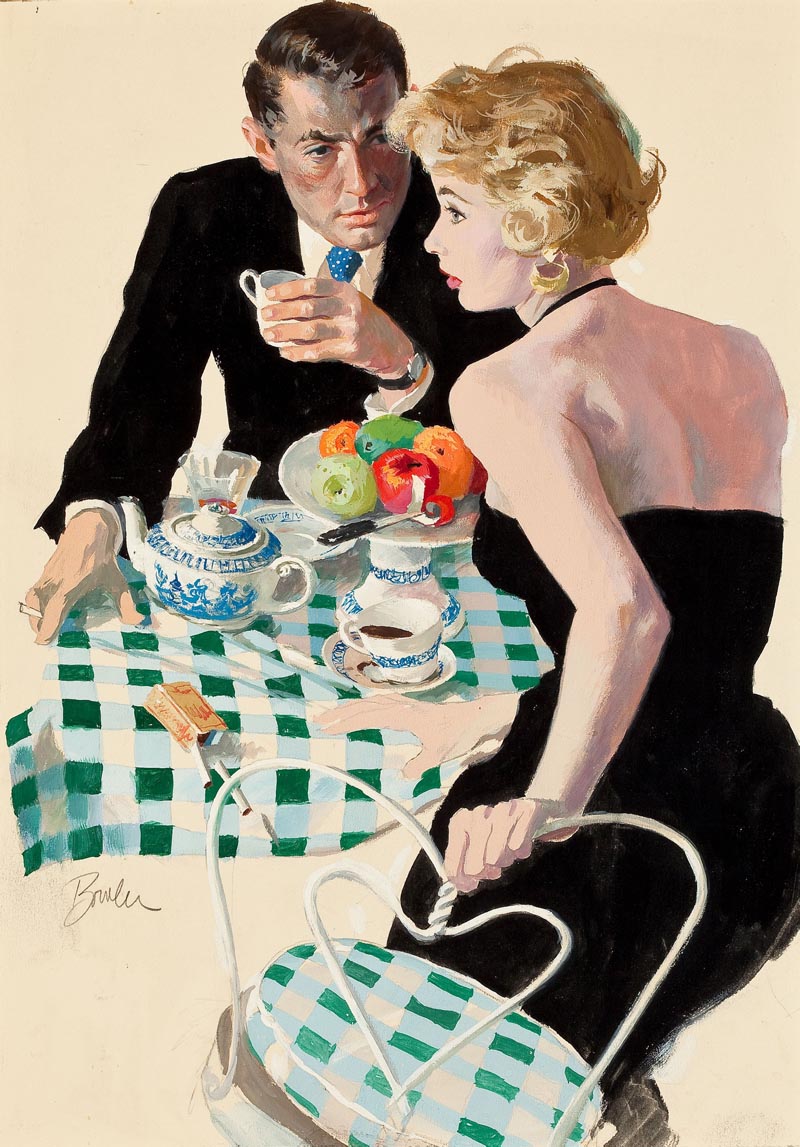
On the Heritage Auctions website, I found a great scan of the original art of that piece...

Bowler45

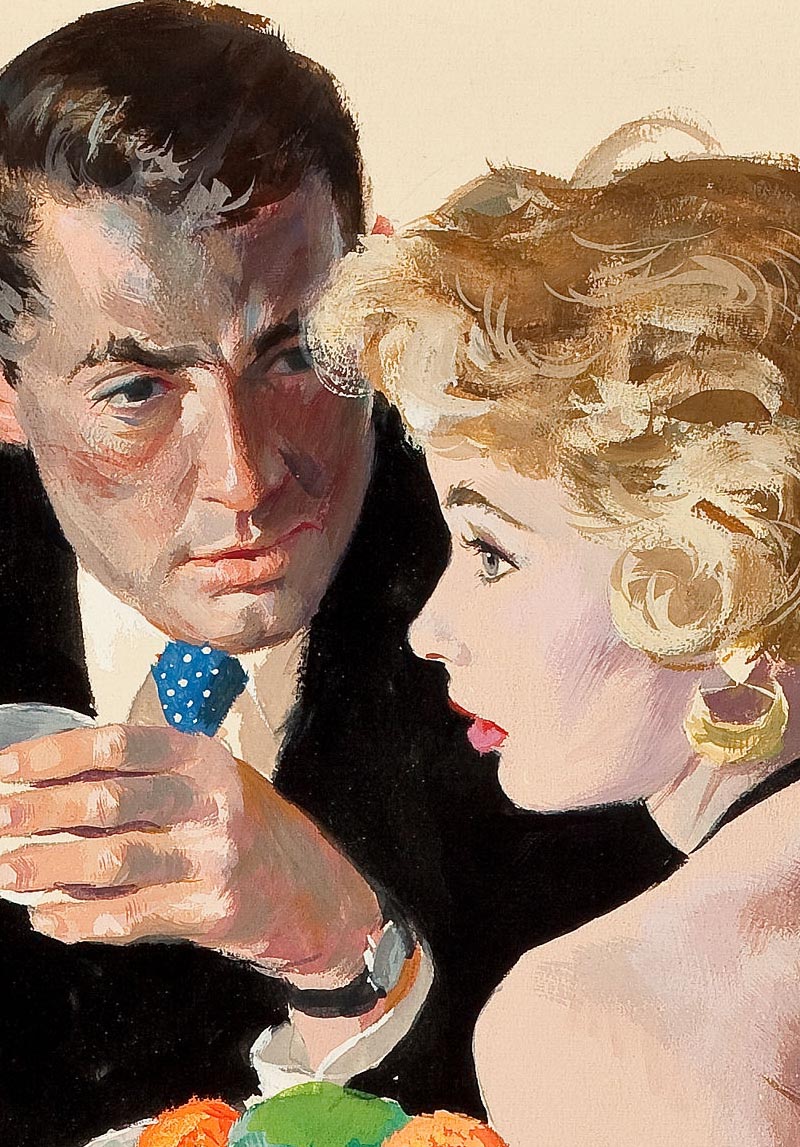
... I mean you can literally see every brush stroke.

Bowler45.detail01

LP: I guess - am I correct to assume - that at this point you were working in gouache?

JB: Gouache, yeah. Designer's Colours.

LP: Ok. And it's fairly evident looking at this piece that you weren't really mixing and blending the paint so much as laying down one colour over another, using the opacity of the gouache. Was that something that came very easily to you or was that a technique you learned at Cooper's?

JB: I think it was something I learned at Cooper's, watching Coby, mainly.

LP: When you consider how you work today in oils and the way you worked back then in gouache; is there a relationship between the two ways, do you think?

JB: In a way there is, except I used to do a lot of drawing in those days. And that whole business of being afraid to lose your drawing because you'll never get it back? Once I got over that - that's when I really started to have fun.

Bowler79

JB: You can always get the drawing back. And mainly reading about how Sargent painted and Sorolla and Zorn - all of these guys had a lot written about how they approach painting and that's where I get a lot of the stuff... and then I have to do it... and then I say, "Oohhh, that's how they did it."

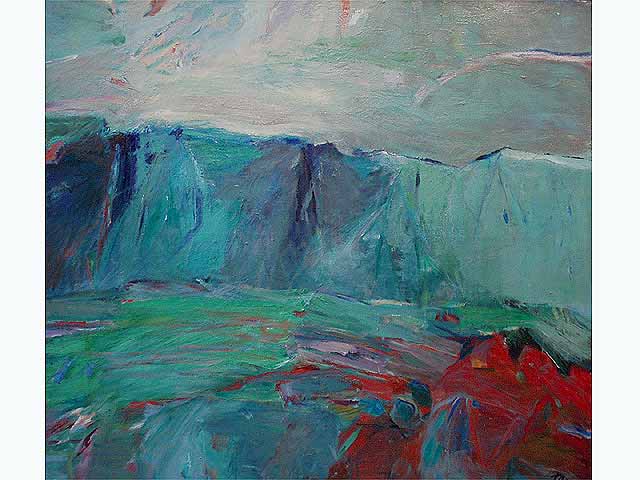
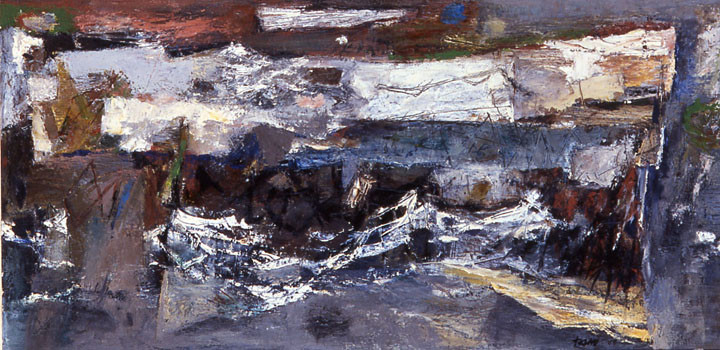
LP: From reading about the Cooper studio and especially from talking with Murray Tinkelman, there came a point in the mid-to-late '50s where he introduced you guys to a painter named Reuben Tam.

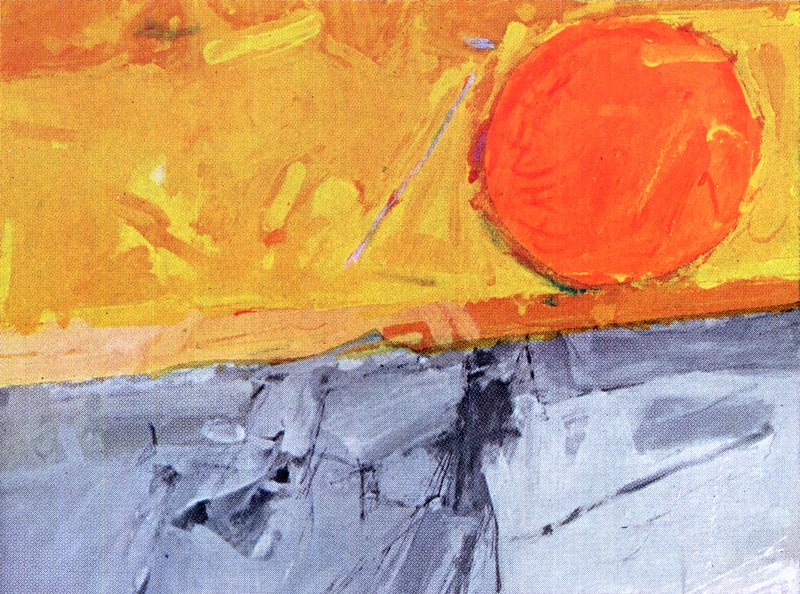
(Below, "The Weathering of Kauai" By Reuben Tam, year unknown)
3136th

I know that, subsequently, a bunch of guys from Cooper's started going to Tam's painting classes... were you among that group? Was Tam an influence on you as well?

JB: Well I had gotten polio in the fall of 1958, and when I was able to come back on crutches and everything I couldn't really sign up for it. It killed me because Bill Whittingham and Coby and all these guys were signing up for this class because of Murray. Of course [Bernie] D'Andrea had been there for a while, studying with Tam. But I did go to the critiques. Once a month he'd have a big critique. And I'd go over and listen in on a couple of hours of the most incredible critiques of about sixty paintings. The guy was a master.

("Ominous Reef" by Reuben Tam, year unknown)
collector18big

LP: So you didn't actually get to paint in Reuben Tam's class but you at least got some influence from listening in on the critiques.

JB: I sure did. Yeah.

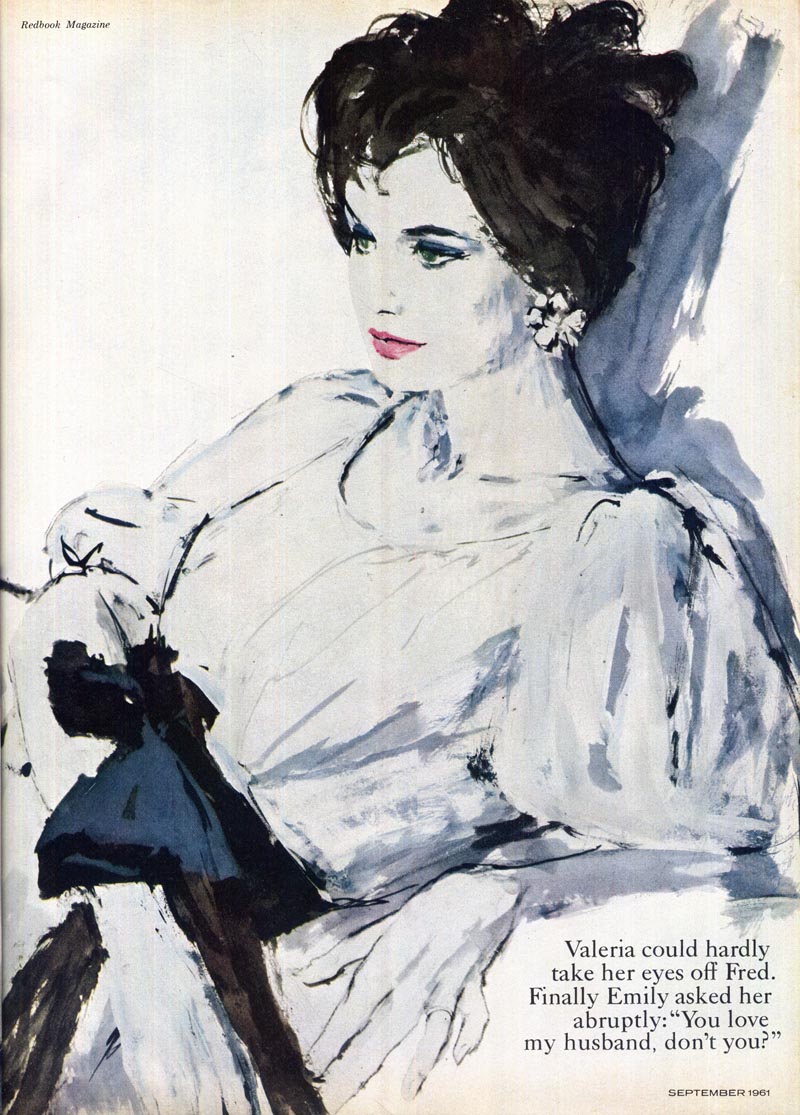
LP: That's interesting because when I look at your work from around 1960/'61 I can see a change... a stylistic change, a technique change... maybe that was the influence of Reuben Tam?

(Below, Joe Bowler illustration for Redbook, September 1961)
Bowler49

JB: Well, Tam, yes, plus Murray dragging me to every show of abstract expressionists that he could get me to.

LP: Really?

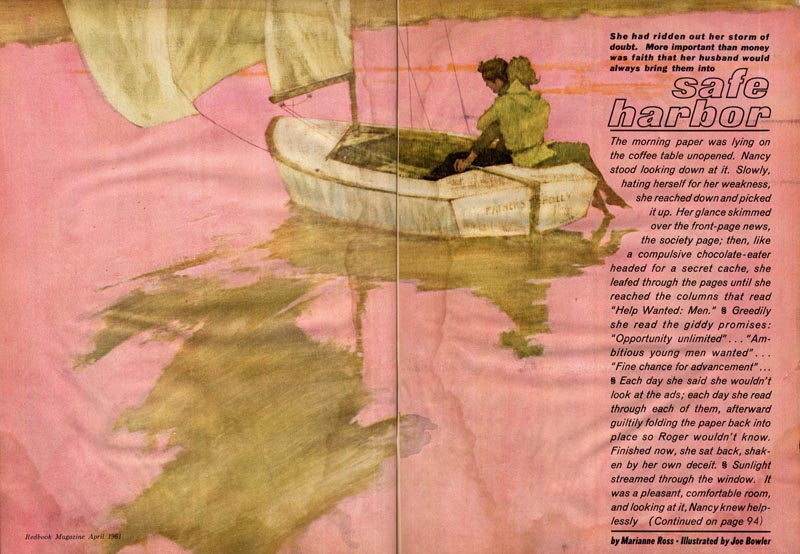
JB: Yeah. Murray was bound and determined to teach me about that group. And of course that was a time when all of them - Pollock and Kline and DeKoenig and all the major guys, plus the second rung, would have these shows that we would go to. And Murray would explain these things to me... so in the end I was influenced a lot by that. Not that you'd ever see me going that way (chuckles) but there was really a tremendous amount of stuff going on at that time that influenced me.

(Below, Joe Bowler illustration for Redbook, April 1961)
Bowler41

LP: Before Murray started explaining it to you, I'm sure you must have seen articles in magazines or the arts section of the paper about it. Initially did you think, "This stuff looks like a bunch of baloney."?

JB: Well, yeah, totally, because I didn't understand a thing about it. And Murray was doing stuff at the time. He was with Tam (and he wasn't making any money at Cooper's) so he'd bring these paintings in when he'd get 'em done - these great big 5'x5' abstract expressionist paintings - and auction them off.

(Below, 'Me' by William Saroyan, illustrated by Murray Tinkelman, 1970)
Tinkelman37

LP: No kidding?

JB: Yeah. And sometimes he'd get fifteen bucks (we both chuckle) for one of these beautiful big things. In fact I got one and I had it for years! Until the paint started to flake off. (Joe chuckles) A lot of these guys, they didn't really care about the quality of the paint they were using. They were using house paint and dime store enamels... but that didn't matter - it was the moment, you know - you had to do it 'in the moment'.

That's why it's amazing; you know, Bernie D'Andrea, he's got a huge amount of big abstract paintings that he did. Semi-abstract, figurative abstract expressionist..."

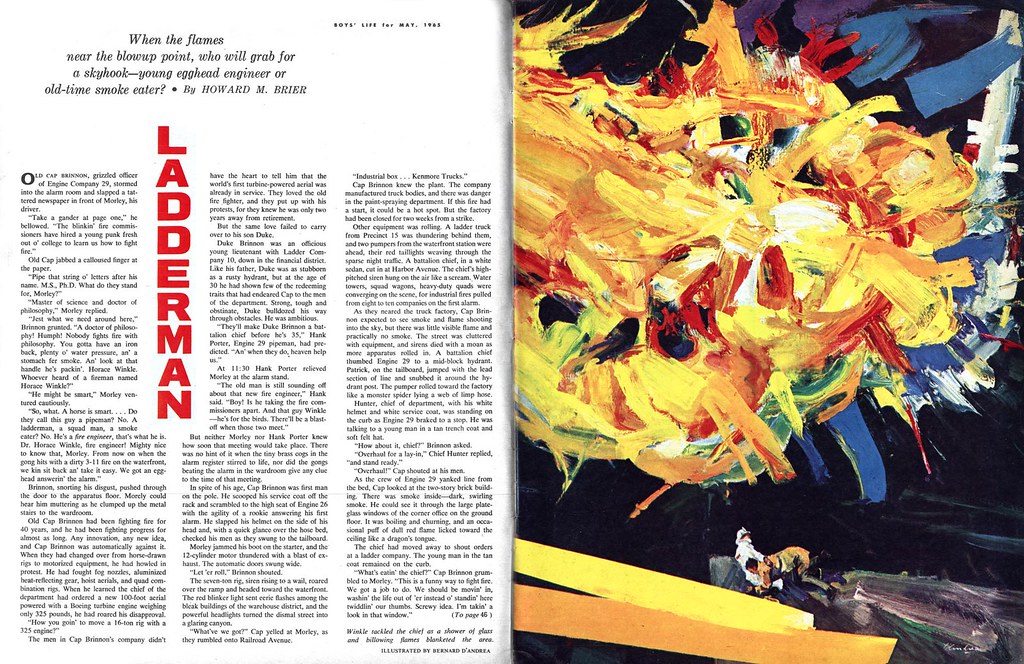
LP: I've actually got a few issues of Boy's Life that have Bernie D'Andrea illustrations in them that are pretty much abstract expressionist paintings.

(Below, Bernie D'Andrea illustration for Boy's Life, May 1965)
D'Andrea06.jpg

JB: Bernie just had a show last year at the museum in Savannah of about twenty of these huge abstract paintings and they're in beautiful condition. He used nothing but the best materials.

Continued tomorrow

* To see recent works by the artist, visit Joe Bowler's website
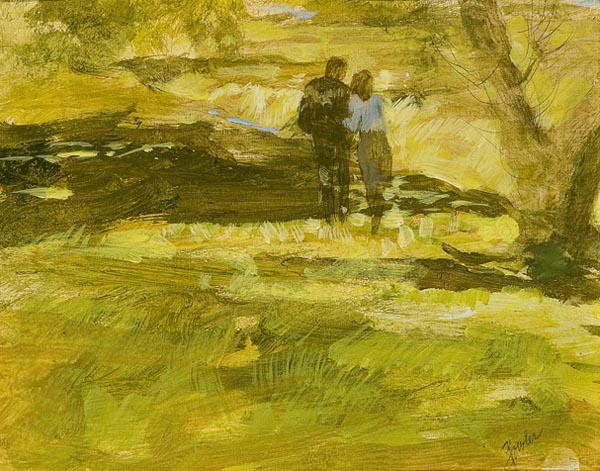
* Thanks to Heritage Auctions for allowing me to use a scan from their image archives in today's post.

Tuesday, January 22, 2013

Joe Bowler Interview, Part 4: Influences and Art Process

Last week, in Parts 1, 2 and 3 of this interview, Joe described the early years of his life, the beginning of his professional career, and his days at the Charles E. Cooper studio. Today Joe shares his thoughts on some of those who impacted his work in one way or another during the 1950s and into the '60s... ~ Leif Peng

LP: The guy who seems to have been a huge influence on everybody at the time was Al Parker.

JB: Oh yeah.

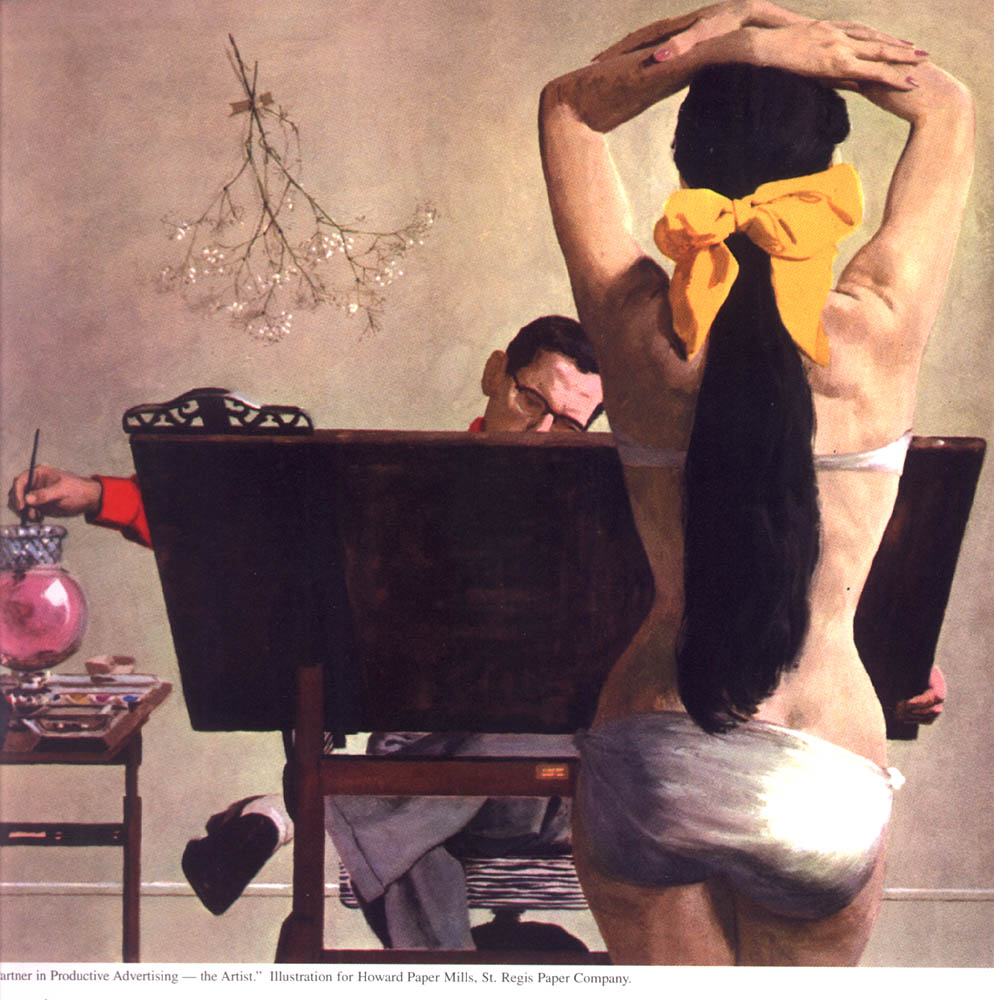
(Below, Al Parker promo illustration for Howard Paper Mills, year unknown)
parker33color

LP: Was he someone whose work you were looking at?

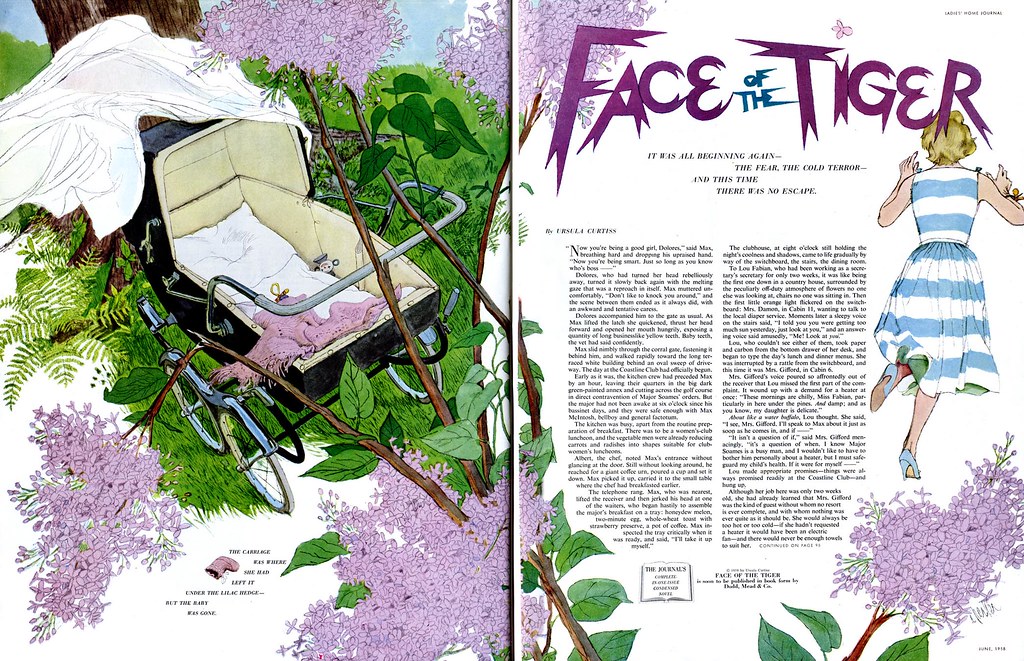
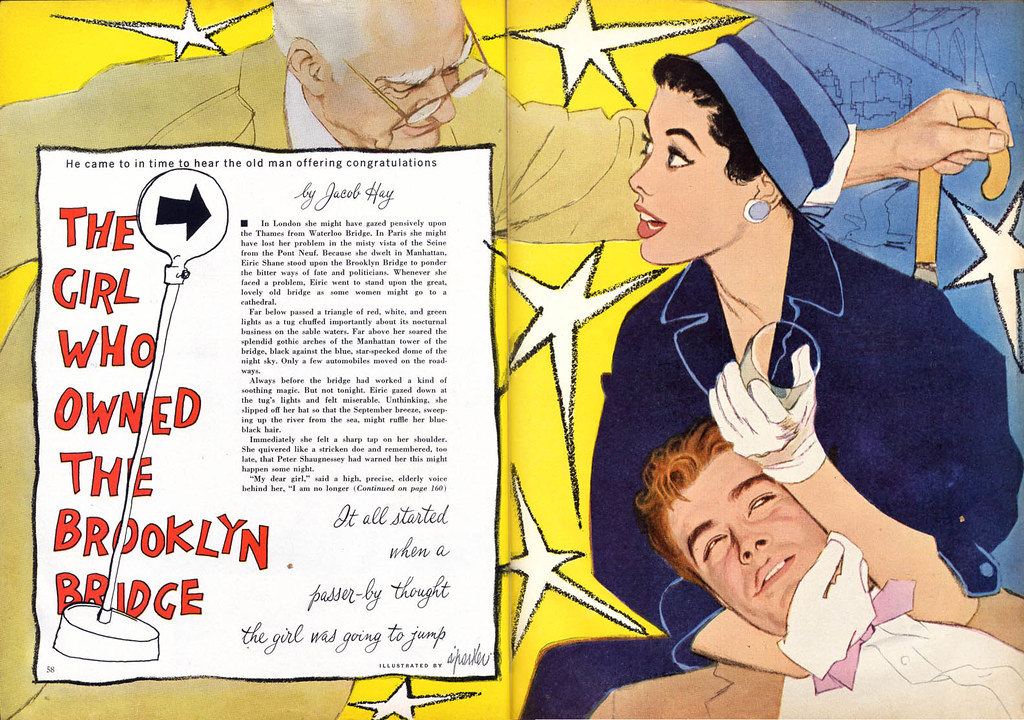
JB: Absolutely. Al Parker was the favourite of all the artists at Cooper's. In fact we went to the old book stores and bought the old magazines and kept an incredible file on Parker. He was the major changer of the way illustration looked, from the oil painting period to the whole 'designed double page spread' type of thing.

(Below, Al Parker DPS from Ladies Home Journal, June 1958)
Parker70.jpg

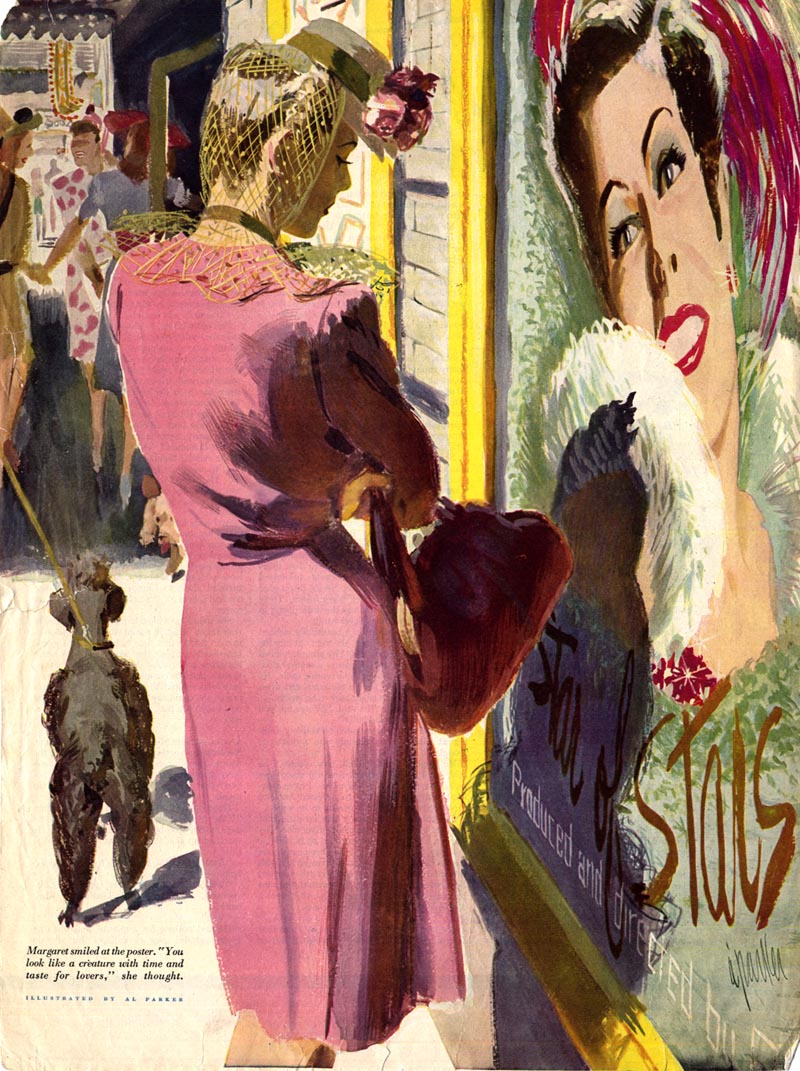
I remember one time I delivered a job to, I think it was John English - he was the art director at Good Housekeeping before Suran Ermoyan - and another package came in while he was looking at mine and he says, "Oh, that's from Parker." And my mouth was watering as he opened it. (we both chuckle)

(Below, Al Parker illustration from Good Housekeeping, 1950s)
Parker04

And he opened it and I said, "Oh man, look at that." and he shook his head. I said, "What's the matter?" and he said, "You know; I love it, you love it, all the artists love it... but I get very little reaction from the public to Parker's work."

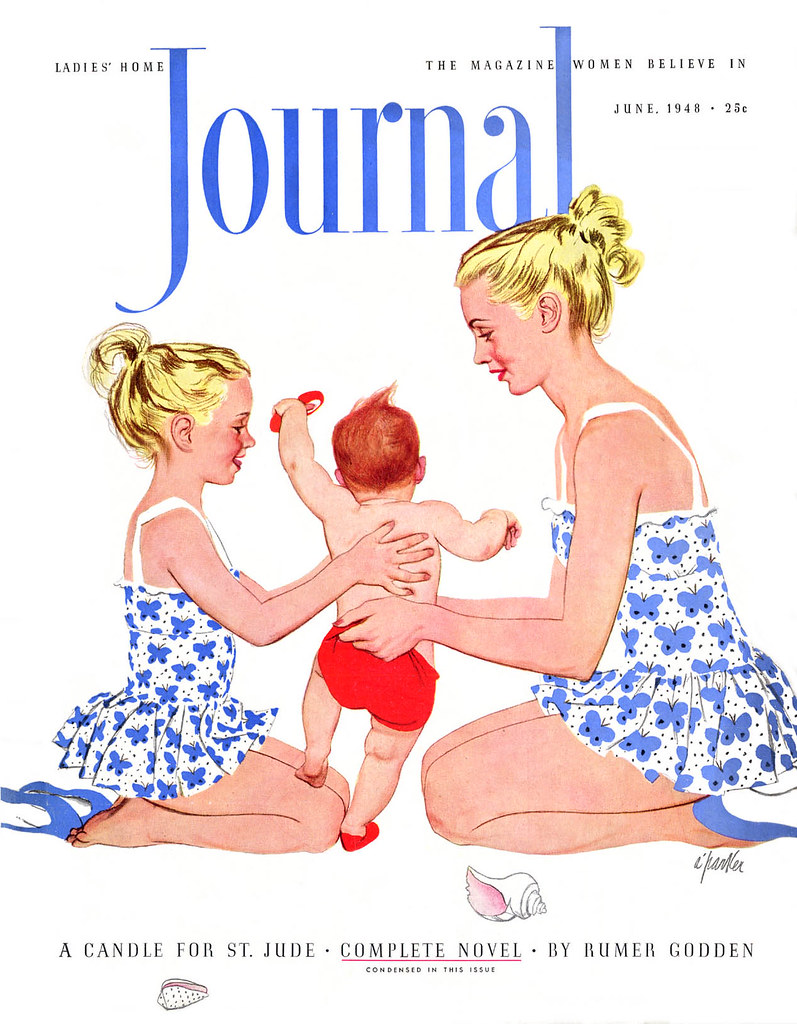
And he never really had that 'mass-appeal'. Even though he did those beautiful mother-daughter covers for Ladies Home Journal for all those years...

Parker12

... he never really had the sort of name where you could go out on the street and ask anybody. They'd tell you Coby and Jon Whitcomb and Norman Rockwell, but if you said, "What about Al Parker?" they'd say, "Who?"

(Below, Al Parker illustration, year and publication unknown)
Parker132

LP: Do you think that was because Parker's women weren't so idealized as Jon Whitcomb's or Coby's?

JB: Yes. Very much so. He wasn't a glamour illustrator and that's what they [the public] were looking for.

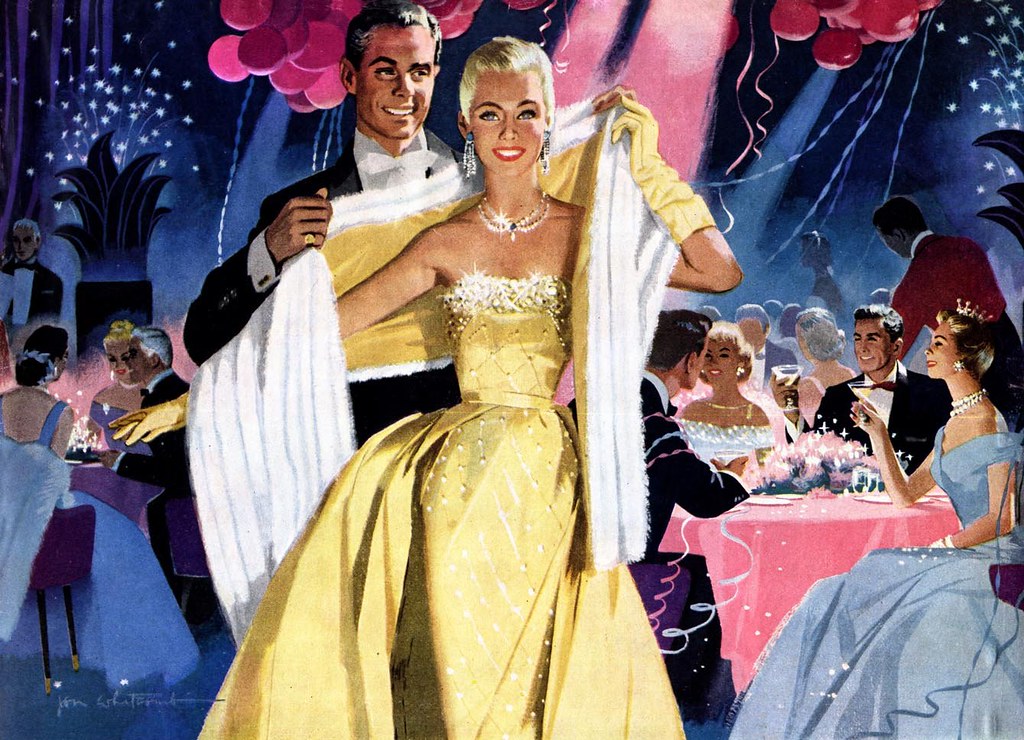
(Below, Jon Whitcomb illustration, Saturday Evening Post, 1956)
Whitcomb39.detail01.jpg

JB: Rockwell was all homespun and small town and Jon Whitcomb was the premier glamour illustrator, as was Coby and a bunch of them. Because of my relationship with Coby, I just gravitated towards that.

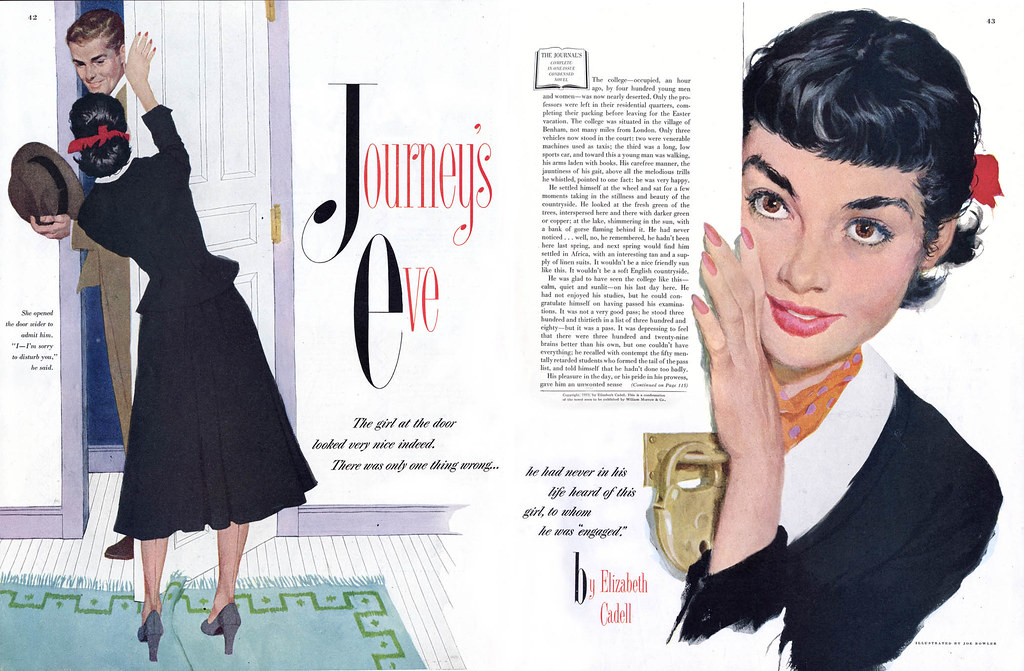
(Below, Joe Bowler DPS from Ladies Home Journal, March 1953)
Bowler03

JB: Parker was one of the most creative minds in the business. Every time he did an illustration you just went, "Wow!"

LP: Did you ever have a chance to meet Al Parker?

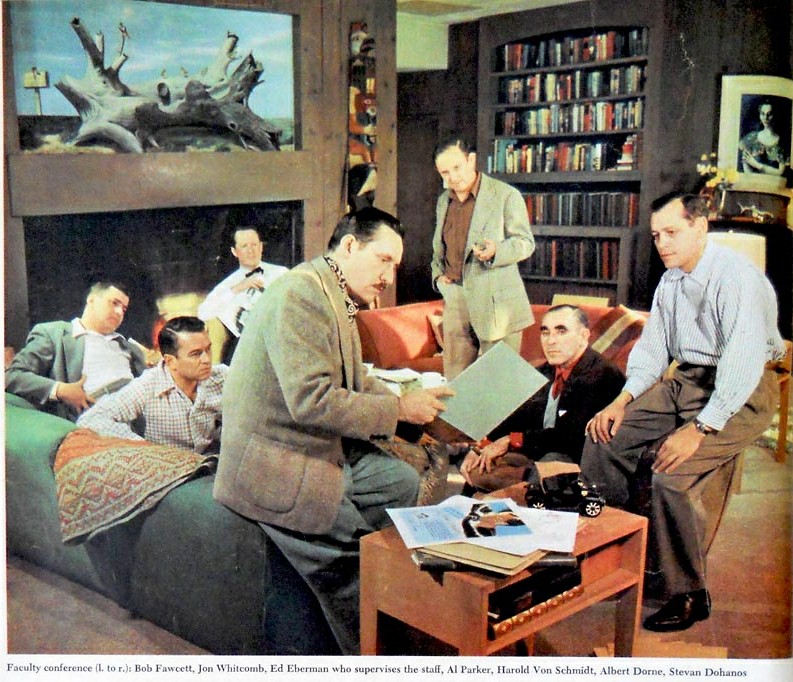
JB: Oh yeah, sure. At the Society of Illustrators. I didn't know him well but every now and then he'd be up for lunch. In fact one time I was having a drink at the club after lunch and it got to be the cocktail hour and all these famous guys happened to be up there... Al Dorne and Parker and a bunch of others. And they all decided to go out to eat and I decided to trail along. And I remember we were all standing at a light at 61st and Lexington Avenue when Al Dorne stopped and said, "You know, we oughta start a correspondence school." And they all said, yeah, and started to talk about it. And I realized later that that was the first time they seriously talked about it. I always sort of thought, "Wow, I was standing there at the beginning of the Famous Artists School!"

Dorne159.detail01

LP: Wow. And to think; at that moment you were standing there, nobody would have imagined that it would go on to generate millions upon millions of dollars.

JB: Yeah.

LP: Now, there's a passage in Neil Shapiro's article on the Cooper studio - and I've heard this directly from Murray Tinkelman as well - that late in the 1950s there was one of these 'bounced jobs' that came in for corrections. And that everybody gathered around this painting and that you looked at it and said, "I dunno who did this but the business is never gonna be the same."

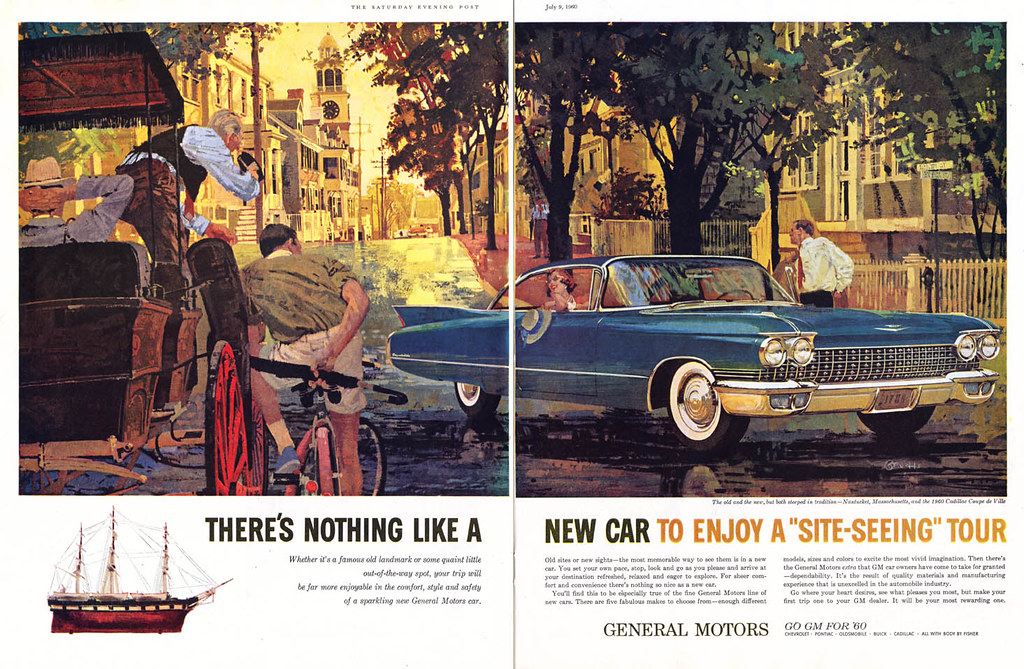
JB: Oh I remember that... it was for Ford. We'd done the Ford cars in the studio, plus the figures - I would do the figures and Al Baxter was the car man. Then all of a sudden this thing showed up. And that was Bernie Fuchs.

(Below, auto ad by Bernie Fuchs, 1959/'60)
Fuchs01.JPG

LP: And what was it about that painting that made you - ?

JB: It was the way he portrayed the attitudes of the people. They were... 'real'. They were not posing. We always had expressions and hands flying and doing all this kinda stuff. But he would just go out and photograph a bunch of people 'hangin' around!' (Joe laughs) And then he'd paint 'em that way and it looked so great. That was really the big difference.

(Below, Bernie Fuchs advertising illo, 1960)
Fuchs100

LP: So did Fuchs' work influence you at that point? Did you start looking for it?

JB: Well, I looked for it because I loved it - but that was when I started to see a bunch of people imitating Bernie Fuchs. I think I said it in an interview once, after that, every month it was like, "Can you top this?" and somebody'd come up with a new technique. And all of a sudden everybody was trying to be Bernie Fuchs.

LP: Right.

JB: And I couldn't be. I went the other way. I went more and more traditional. The influence was to do consistently wonderful work, but he didn't influence me on my style.

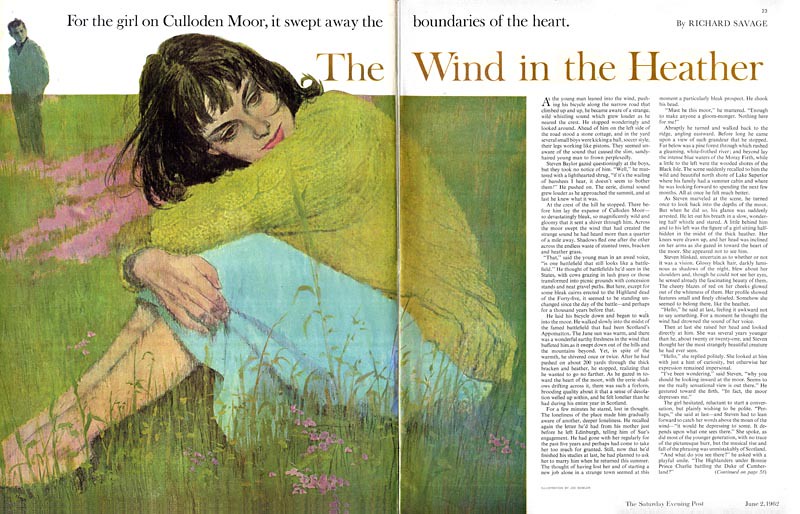
(Below, Joe Bowler DPS from the Saturday Evening Post, June 1962)
Bowler59

LP: I know exactly where you made that statement: it was in a 1967 interview in American Artist magazine.

JB: Oh yes!

LP: In there you said, "I keep up with all the new media, the new techniques. Like everybody else, I use acrylics. I experiment with collage and all sorts of accidental effects. I use cameras and projection equipment. But I'm always myself. I don't let any of this take over and become technique for it's own sake."

(Below, Joe Bowler DPS from McCall's, January 1967)
Bowler43

LP: I think what you were saying is you were willing to try new things but never willing to sacrifice the basics for the sake of gimmicks.

JB: Exactly right.

LP: So having said that; another guy came along around the same time as Bernie Fuchs and made a big splash: Bob Peak.

JB: Oh wow...

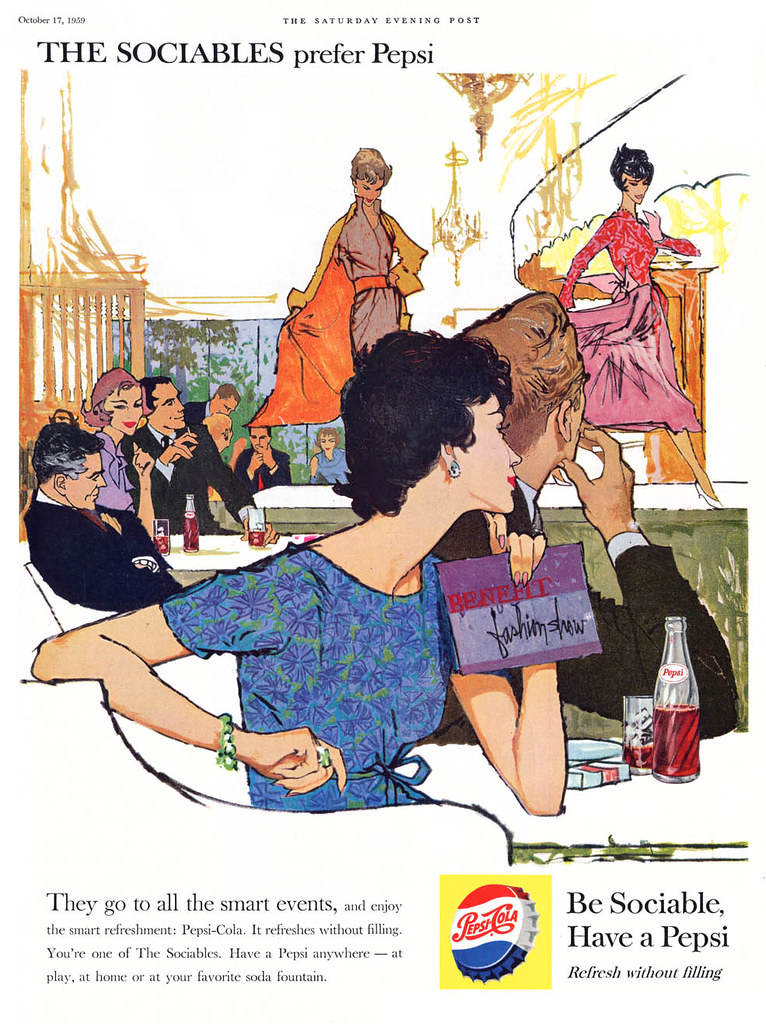
(Below, Bob Peak Pepsi ad, October 1959)
Peak11

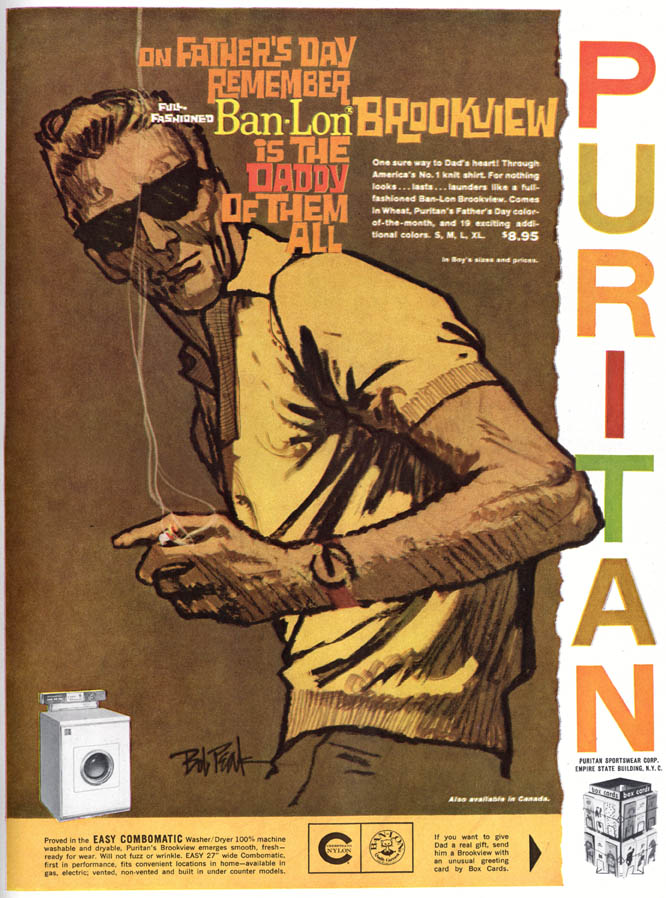
LP: So what I'm wondering is, did you notice Bob Peak's work and what did you think about it?

JB: Well, I liked the work very much. It was all his own. I just said to myself, this has got to be the best commercial illustrator I've ever seen. This guy could do anything and do it well. But as far as anybody I looked to for inspiration; no. Other than just realizing how good he was at what he did.

(Below, Bob Peak advertising art, late 1950s)
Peak03.JPG

I did try a bit of everything at that time. I did a lot of just charcoal drawings with coloured ink washes and things like that, which were different, I guess, for me.

(Below, Joe Bowler illustration, year and publication unknown)
Bowler69

LP: The '60s were a difficult time for a lot of illustrators, but as the author of the American Artist article says, you're one of the handful who seems to have found a way to stay on top. Can you tell me a little about those times and how you managed to keep getting a steady stream of assignments?

JB: Well it was part of my philosophy of saying, "I'm going to do something that they'll always want." Whatever I was doing or thinking, it was working for me.

Joe Bowler

Continued tomorrow

* To see recent works by the artist, visit Joe Bowler's website
* Thanks to Isabel for allowing me to use a scan from her Joe Bowler set on Flickr in today's post. Thanks also to oldcarguy41 for allowing me to use a Bowler illustration from his Flickr image archives.